Category Archives: BIBLE VERSIONS AND MANUSCRIPTS

What is the “falling away” of 2 Thessalonians 2:3?

WHAT IS THE “FALLING AWAY” OF 2 THESSALONIANS 2:3?

by Shawn Brasseaux

The King James Bible says in 2 Thessalonians 2:3: “Let no man deceive you by any means: for that day shall not come, except there come a falling away first, and that man of sin be revealed, the son of perdition.” What is this “falling away?” Is it a reference to the Rapture, our being caught up into heaven as members of the Church the Body of Christ? Or, is it perhaps a reference to some other event? Beloved, let us be Bereans and compare verses, rather than simply shouting “Amen” to preachers’ sermons on the subject!

Unfortunately, some people—even in “Bible-loving” and “Bible-defending” circles—absolutely detest the King James Bible. Seminary or Bible College has so polluted their minds and hearts. These individuals whom Bible institutions corrupted, they “graduate” and pollute common church members with their “education.” They go on to produce “study Bibles,” “better” translations, commentaries, Hebrew and Greek grammars, and other worthless books parading as “Christian” literature. These very people—educated in error—currently lead and teach in most local assemblies and other “Bible” groups. Thus, today, the average church leader and the average church member alike view the King James Bible as anything but “scholarly” and “reliable.”

The Bible publishers make sure their advertisements report largely just enough information for you to have an “easy-to-read” contemporary perversion. To tell you the full story of the various versions of the “English Bible,” which they often do not know themselves (or knowingly and willfully withhold from the public), that information would cause you to use a King James Bible and you would never want to buy one of their 100 translations they want to $ell you! Many people—including Christians—have been educated to attack God’s preserved Word in English. If you believe in a perfect King James Bible, these “Bible-believers” will ridicule and slander you for disagreeing with their “scholarly” (ha!!) position. They have been poisoned by the pro-Roman-Catholic mentality that “educated clergy” must always interpret God’s Word. They have been polluted with the false idea that the Holy Spirit used Roman Catholic manuscripts as a repository for His precious Words. They assume that He sanctions the use of those manuscripts to “correct” the Protestant Bible Text of the Reformation. All in the name of “unbelieving scholarship” we are urged to toss out God’s precious Words and pick up the worthless teachings of men. Never! Never! Never! Again, I say, Never!

One brother in Christ, whom I love dearly, is nevertheless polluted because he always corrects 2 Thessalonians 2:3 in the King James Bible—he never picks on the modern English Bibles whose verse uses the same term that he dislikes!! (He refused to heed my advice on that subject many times so I have no further dealings with him.) A “scholar” had written something about the verse that appealed to him. Thus, ever since, this brother has repeated the error time and time again when teaching the verse. He always wants to change “a falling away” to “the departure,” claiming that “everybody does it” with that verse. (Of course, I do not do it, and I know plenty of people who do not do it, so not “everybody does it!”) According to this deceived brother, and those who agree with him, the verse should read: “Let no man deceive you by any means: for that day shall not come, except there come the departure first, and that man of sin be revealed, the son of perdition.” Is that a sound conclusion? Do not take my word for it! Notice the following research I have gathered especially for this study.

Strangely, while people often “run to the Greek” to “disprove” the King James Bible, I see why they do not “run to the Greek” in 2 Thessalonians 2:3. Whether the Textus Receptus (King James Greek New Testament) or the Nestle-Aland Novum Testamentum Graece (modern versions’ Greek New Testament), the word rendered “falling away” is apostasia. Of course, you need no theological degree to see that that term is where our English word “apostasy” originated. “Apostasy” simply means “a defection from truth, falling away, forsaking.” For the record, I quote Strong’s Greek Dictionary:

“G646 ἀποστασία
Pronounced ap-os-tas-ee’-ah
feminine of the same as 647; defection from truth (properly, the state) (“apostasy”):—falling away, forsake.”

As noted above, the word apostasia (G646) is the feminine form of apostasion (G647), which itself means “separative, i.e. (specially) divorce” or “(writing of) divorcement.” Apostasion appears twice in Matthew and once in Mark—Matthew 5:31, Matthew 19:7, and Mark 10:4 (Moses writing the “bill of divorcement” under the Law economy). The idea is one party leaving another. Now, carry that concept over into 2 Thessalonians 2:3, and it becomes clear.

Someone is leaving someone else in 2 Thessalonians 2:3. It is not the Body of Christ leaving Earth, but rather the nation Israel leaving Moses. Israel is so far removed from the divine revelation given to her through Moses. The Jews have been duped into accepting the Antichrist (“man of sin, son of perdition”). They have embraced the Antichrist and Baal worship, idolatry that the Law of Moses repeatedly warned against! Friends, remember, whenever God’s Word is ignored, a vacuum is left, and one’s heart and mind sucks up everything error. Spiritual light rejected (Psalm 119:130) becomes darkness. They have left Moses and the Jesus Christ he predicted (Deuteronomy 18:15,18,19; Acts 3:22-23). Now, they have nothing but the Antichrist, the false Messiah, the man Satan will use to doom them with a devilish religion.

Once Israel leaves the integrity of their Old Testament prophets, chiefly Moses’ writings, once they ignore Jesus as their Messiah/Christ, they will open themselves up to Satan’s will, and Satan will be more than eager to put the Antichrist into power and damn Israel. They have not heeded the ancient warning of the coming Antichrist (see Isaiah 10:5; Daniel 7:8,19-26; Daniel 8:9,22-25; Daniel 9:26-27; Daniel 11:21,36-38; Zechariah 11:17; et cetera). They have abandoned JEHOVAH God, the one true God, and now, they have nothing but Satan’s plan for them. God will give unbelieving Israel just what they want!

We read in 2 Thessalonians 2:9-12: “[9] Even him [Antichrist], whose coming is after the working of Satan with all power and signs and lying wonders, [10] And with all deceivableness of unrighteousness in them that perish; because they received not the love of the truth, that they might be saved. [11] And for this cause God shall send them strong delusion, that they should believe a lie: [12] That they all might be damned who believed not the truth, but had pleasure in unrighteousness.”

In conclusion, it should be pointed out that the Greek word translated “falling away” in 2 Thessalonians 2:3 is rendered in Acts 21:21 as “forsake.” Note, “And they are informed of thee, that thou teachest all the Jews which are among the Gentiles to forsake Moses, saying that they ought not to circumcise their children, neither to walk after the customs.” It had nothing to do with “departing from one place to another” (as in the Rapture, or some other physical relocation). It meant leaving the truth and going after other teaching. That is the meaning in Acts 21:21 and that is the meaning in 2 Thessalonians 2:3. Israel will be so far led away from the truth God gave her through the Law and the Prophets (Old Testament). They did not want God’s truth so He will give them error instead (Romans 1:17-32).

Also see:
» How could ‘wise’ King Solomon let foreign women deceive him?
» Should the King James’ “Christ” actually be “Lord” in 2 Thessalonians 2:2?
» Does Hebrews 10:25 really teach we must attend church?

Why does Acts 2:35 use “foes” but Psalm 110:1 use “enemies?”

WHY DOES ACTS 2:35 USE “FOES” BUT PSALM 110:1 USE “ENEMIES?”

by Shawn Brasseaux

Psalm 110:1 says, “The LORD said unto my Lord, Sit thou at my right hand, until I make thine enemies thy footstool.” The New Testament quotes this verse six times—Matthew 22:44, Mark 12:36, Luke 20:43, Acts 2:35, Hebrews 1:13, and Hebrews 10:13. In Matthew, Mark, Luke and Hebrews, our King James translators rendered the Greek word ekthros as “enemies.” (That word is related to the Greek term for “hate,” as in “hateful” or “hater.”) Yet, in Acts 2:35, they translated ekthros as “foes.” Unlike the causal Bible reader, who simply skims over the word change (the word change is absent from modern versions), we Berean Bible students pause and use some critical thinking skills by asking, “Why this change in terminology in our King James Bible?”

Furthermore, all the major modern English “bible” translations—NIV, NASB, NKJV, NRSV, Amplified, HCSB, and NLT—use “enemies” in Acts 2:35, as they do with the rest of the New Testament quotations of Psalm 110:1. Why did our King James scholars not render ekthros the same way on all six occasions as the modern translators did? Again, why this change in terminology? Let me share with you what I think is the most likely explanation.

The Holy Spirit’s great sermon through the Apostle Peter on the day of Pentecost included the following words (Acts 2:34-35): “[34] For David is not ascended into the heavens: but he saith himself, The Lord said unto my Lord, Sit thou on my right hand, [35] Until I make thy foes thy footstool.” This was a quote of Psalm 110:1: “The LORD said unto my Lord, Sit thou at my right hand, until I make thine enemies thy footstool.” Why did our 1611 translators have Peter say “foes” instead of “enemies” as Psalm 110:1 had it? It helps to have some definitions.

An “enemy” is someone who is against you, but who may not actually be engaged in combat with you at the present moment. A “foe,” however, is someone who is actively fighting against you in the present. “Foe” is more descriptive because it is related to the word “feud” (as in fight or struggle, prolonged hostility and conflict between two parties). “Enemy” is from the Old French enemi, from the Latin inimicus, from in- ‘not’ + amicus ‘friend.’ These etymologies help us in understanding why Acts 2:35 reads oddly in our King James Bible.

Israel at the time of Acts chapter 2, Pentecost, is not simply against God but has actively opposed God (by killing His Son, Jesus). Israel is not listening to His apostles preach God’s Word in Acts chapter 2. In fact, they are mocking the apostles, claiming they are drunk with wine to be speaking in these various known human languages. They are mocking the ministry of the Holy Spirit through the 12 apostles: “[13] Others mocking said, These men are full of new wine. [14] But Peter, standing up with the eleven, lifted up his voice, and said unto them, Ye men of Judaea, and all ye that dwell at Jerusalem, be this known unto you, and hearken to my words: [15] For these are not drunken, as ye suppose, seeing it is but the third hour of the day.”

As a little side-note, the King James New Testament uses “foe” one other time besides Acts 2:35. It is Matthew 10:36: “And a man’s foes shall be they of his own household.” This is the Lord Jesus describing unbelieving Jews betraying their believing family members, and turning them over to the Antichrist for imprisonment or death sentencing. Again, this is not simply a case of enemies, but foes, people actively fighting and persistently rebelling against the God of the Bible. Peter was making sure Israel was warned that Jesus Christ was coming back to take care of His enemies, yes, but more specifically, His “foes”—them!

Also see:
» Why did Jesus Christ stand in Acts 7:55-56?
» Is “Easter” a mistranslation in the King James Bible in Acts 12:4?
» Should it be “Christ” or “Lord” in 2 Thessalonians 2:2?

Who wrote the book of Hebrews?

WHO WROTE THE BOOK OF HEBREWS?

by Shawn Brasseaux

Various church fathers and theologians down through the ages have speculated as to the writer of the book of Hebrews. Tertullian thought Barnabas wrote Hebrews. Martin Luther believed it was Apollos. Some have suggested that Luke was its writer. Certain Bibles have titled the book “The Epistle of Paul the Apostle to the Hebrews.” Many believe Paul wrote Hebrews. Is there any way to definitively identify (or exclude) Paul as the writer of the book of Hebrews? Does it really matter whether or not Paul wrote Hebrews?

In this, our special edition 150th Bible Q&A study, we will consider the above questions. We aim to survey the book of Hebrews in order to shed some light on its writer’s identity. The following treatise is the fruit of several years of prayerful and thoughtful Bible study. It is a very in-depth, and yet, a very enlightening, study. Dear reader, may you use this article to learn what most Bible readers never grasp in their whole lives. The information contained therein is so greatly needed about a topic so many have confused. It is with great urgency that we send it out to the glory of our Lord Jesus Christ! May you, dear reader, search and see the Bible for yourself, and not take my word for anything.

SECTION I. PAUL AND “UNLUCKY” NUMBER THIRTEEN?

To begin, I think it important to point out that, a famous preacher, a sufferer of triskaidekaphobia, once claimed that it was “unlucky” for Paul to have written only 13 Bible books. Hence, this superstitious “brother” believed that Paul wrote a fourteenth book, the book of Hebrews. Dear friends, an espousal to such a belief is not done in faith. It is superstition, plain and simple, and we are not superstitious. We are Bible believers. We need to appeal to the internal evidence of Hebrews, not some external fantasy, as to identify the book’s human writer. Verses believed in order to validate or nullify an idea, provide a much better foundation for our Christian life than opinions and hunches.

SECTION II. THE WRITER OF HEBREWS FOCUSED ON “THE WORLD TO COME”

We read in Hebrews 2:3-5: “[3] How shall we escape, if we neglect so great salvation; which at the first began to be spoken by the Lord, and was confirmed unto us by them that heard him; [4] God also bearing them witness, both with signs and wonders, and with divers miracles, and gifts of the Holy Ghost, according to his own will? [5] For unto the angels hath he not put in subjection the world to come, whereof we speak.”

As we can clearly see, the book of Hebrews says that it describes the “world to come” (verse 5). It involves Israel’s future redemption and restoration. Hebrews does not involve “but now” (Ephesians 2:13)—“but now” is our dispensation, the age in which we live. Hebrews focuses on the early Acts period (during which Paul/Saul was still lost), early Acts involving the beginning of the last days of Israel’s program (see Acts 2:17; cf. Hebrews 1:2). The teachings in the book of Hebrews are built on the foundation of Jesus Christ’s earthly ministry (Matthew through John). Paul, however, did not know Jesus Christ after the flesh: “Wherefore henceforth know we no man after the flesh: yea, though we have known Christ after the flesh, yet now henceforth know we him no more” (2 Corinthians 5:16). Paul did not base his ministry on Christ’s earthly ministry. Paul’s apostleship and ministry were in no way connected with Jesus Christ’s earthly ministry (Matthew through John) or Peter and the 11’s ministries (the early part of the book of Acts). Paul’s ministry is Jesus Christ’s heavenly ministry (see Acts 26:19).

SECTION III. THE WRITER OF HEBREWS HAD BEEN TAUGHT DOCTRINE SECOND-HAND

As we saw in Hebrews 2:3 just moments earlier, the writer of Hebrews received second-hand information from the apostles: “How shall we escape, if we neglect so great salvation; which at the first began to be spoken by the Lord, and was confirmed unto us by them that heard him;” Paul never received second-hand information from the 12. According to Galatians 1:11-12, the Lord Jesus taught Paul directly: “[11] But I certify you, brethren, that the gospel which was preached of me is not after man. [12] For I neither received it of man, neither was I taught it, but by the revelation of Jesus Christ.” Notice what Paul wrote when he discussed how he met with Israel’s apostles in Jerusalem: “But of these who seemed to be somewhat, (whatsoever they were it maketh no matter to me: God accepteth no man’s person:) for they who seemed to be somewhat in conference added nothing to me (Galatians 2:6). The 12 apostles did not teach Paul anything. In fact, if you further study Galatians chapter 2, you will learn that Paul taught them something. He taught them the further revelation and advancement of God’s purpose and plan. You can also see Acts chapter 15.

SECTION IV. THE WRITER OF HEBREWS WAS OUTSIDE OF ISRAEL’S APOSTLESHIP

Hebrews 2:3-5 helps us one more to rule out individuals who did not write Hebrews: “[3] How shall we escape, if we neglect so great salvation; which at the first began to be spoken by the Lord, and was confirmed unto us by them that heard him; [4] God also bearing them witness, both with signs and wonders, and with divers miracles, and gifts of the Holy Ghost, according to his own will?”

Notice how the writer of Hebrews refers to people who heard Jesus in His earthly ministry as “them that heard him.” The writer of Hebrews says that what “they” heard “we” heard from them. In other words, the writer of Hebrews is someone who was not present in Matthew through John. Someone present during Christ’s earthly ministry taught doctrine to the writer of the book of Hebrews. Concerning the penning of the book of Hebrews, we can rule out Peter, James, John, et cetera. All of Israel’s 12 apostles can be eliminated as possible writers of Hebrews. The 12 continued throughout Jesus’ earthly ministry. They would not need to hear that information secondhand because they had heard Him firsthand. They had witnessed all those miracles firsthand.

SECTION V. THE WRITER OF HEBREWS DID NOT SIGN HIS NAME

Some have stated that Paul wrote Hebrews without including his name. They say that Paul did not sign his name to Hebrews because the Jews did not like him. It is their contention that, had Paul added his name to the epistle, the Jews would have been thus “turned off” to reading Hebrews. Is this plausible? Could Paul have written Hebrews and just intentionally left off his name so that the Jews would be more accepting of the epistle? This scenario is impossible for two reasons.

Firstly, Paul concluded 2 Thessalonians 3:17: “The salutation of Paul with mine own hand, which is the token in every epistle: so I write.” And he closed Colossians 4:18 with: “The salutation by the hand of me Paul. Remember my bonds. Grace be with you. Amen.” Paul never wrote anything without signing his name to it, either before or after. Romans, the two Corinthian epistles, Galatians, Ephesians, Philippians, Colossians, the two Thessalonian epistles, the two epistles to Timothy, the epistle to Titus, and the epistle to Philemon—all of these epistles begin with the name, “Paul.” Unlike the books of Romans through Philemon, the book of Hebrews neither begins nor ends with Paul’s name. If Paul claimed that he signed every epistle he wrote, and there is no name signed to the book of Hebrews, we have to conclude Paul did not write Hebrews. Would Paul say he signed every epistle he wrote, but then break his word and write an epistle without signing his name? That would be duplicitous, and certainly not characteristic of an apostle of Jesus Christ. The book of Hebrews simply begins with the name “God.” Ultimately, the author of Hebrews was God the Holy Ghost; the human writer is anonymous. God purposefully withheld the name of the human instrument He used.

Secondly, regardless of who wrote it or spoke it, an unbelieving Jew wanted nothing to do with God’s Word. The unbelieving nation of Israel refused to hear from Apostles James, Peter, John, et cetera, in early Acts. Apostate Israel did not like Jesus Christ, either in His earthly ministry or in His apostles’ ministries in early Acts. Unbelieving Israel considered Jesus a fraud. Period. Just look at how violently Israel’s leadership reacted when Stephen rebuked them for killing Jesus (Acts chapter 7). After his great sermon documenting their history of unbelief, the Jews mercilessly stoned their fellow Jew, Stephen, to death! Paul leaving his name off Hebrews because the Jews would reject it, is not persuasive. Its writer aside, the contents alone of the book of Hebrews is unpleasant to someone who refuses to accept Jesus as Messiah. The book of Hebrews emphasizes that Jesus Christ is God’s Son, the fulfillment of the Old Testament economy. If the omission of Paul’s name from Hebrews was done in an effort to make the epistle more acceptable to Jews, should not God have also avoided mentioning Jesus as Christ in the epistle, too? Again, anyone who wrote Hebrews was offensive to apostate Israel because Hebrews itself contains offensive doctrine about Jesus Christ.

See, dear friends, the “incognito-Paul-wrote-Hebrews” idea is unfounded and actually fallacious. When someone says that Paul wrote Hebrews but that he deliberately wrote it anonymously so Israel would accept it, this person (however sincere) has an agenda. They will go to great lengths to hold to Paul’s writing of the book of Hebrews. They refuse to break away from a church tradition, and will grab at anything to prove their preconceived ideas. It should be pointed out that I used to hold to the idea that Paul wrote Hebrews but that he withheld his name to avoid Jewish opposition. Then, I took the time to study my Bible and prayerfully consider those verses. I came to a crossroads—I had to choose between traditions and Scripture. What did I do? I believed the Bible and I tossed out the rest! My church tradition was wrong and the Bible was right. It was a happy day in my Christian life when I came to that realization!

SECTION VI. THE WRITER OF HEBREWS WROTE WITH SOME PAULINE UNDERSTANDING

Hebrews 2:9 says, “But we see Jesus, who was made a little lower than the angels for the suffering of death, crowned with glory and honour; that he by the grace of God should taste death for every man.” Prior to Paul’s ministry and message, the merits of Jesus Christ’s finished crosswork being available to “every man”—that is, to both Jew and Gentile—was a secret. Until Paul, God had only been offering Jews salvation through Jesus Christ (Israel is the “my people” of Isaiah 53:8, the “thy [that is, Daniel’s] people” of Daniel 9:24, the “many” of Matthew 20:28 and Matthew 26:28, and the “you” of Luke 22:20). “Salvation is of the Jews,” the Lord Jesus Himself said in John 4:22.

Since the above is true, the book of Hebrews could not have been written until after Acts chapter 15 (circa A.D. 49-51), where Paul shared with James, Peter, and John, the doctrines that Jesus Christ had taught him post-resurrection and post-ascension (see Galatians 2:1-10). After the Apostle John learned it from Paul, John wrote, “And he is the propitiation for our sins: and not for ours only, but also for the sins of the whole world (1 John 2:2).

Because Hebrews contains snippets of Pauline theology, some have erroneously concluded that Paul wrote Hebrews. In reality, 99 percent of the book of Hebrews is non-Pauline in its content. This observation leads us to understand that Paul did not write Hebrews. Still, we do admit that the writer of Hebrews had learned a portion of Paul’s doctrine from someone (like the writer of Hebrews, that person is also anonymous). The book of Hebrews thus adjusts Israel’s program in light of the Dispensation of Grace that God used to temporarily interrupt Israel’s program. After we pass through Paul’s epistles in the Bible’s canon, Hebrews follows. Hebrews is the first of the Bible’s final nine books to Israel, books whose doctrine will be valid after our Dispensation of Grace.

SECTION VII. THE WRITER OF HEBREWS WROTE PRE-A.D. 70

The Temple in Jerusalem was still operating when the book of Hebrews was written. Israel was still under the Law when Hebrews was written. Notice Hebrews 8:4: “For if he were on earth, he should not be a priest, seeing that there are priests that offer gifts according to the law:” And Hebrews 8:13: “In that he saith, A new covenant, he hath made the first old. Now that which decayeth and waxeth old is ready to vanish away.” And Hebrews 10:11: “And every priest standeth daily ministering and offering oftentimes the same sacrifices, which can never take away sins:” These are present tense verbs, meaning the Levitical priests were still offering sacrifices according to Moses. The armies of Rome destroyed Jerusalem’s Temple in A.D. 70., thus showing us that the book of Hebrews was written prior to A.D. 70.

SECTION VIII. THE WRITER OF HEBREWS KNEW TIMOTHY

The antepenultimate verse of Hebrews says: “Know ye that our brother Timothy is set at liberty; with whom, if he come shortly, I will see you” (13:23). Since Paul and Timothy were together quite often on apostolic journeys (Acts chapter 16 and onward), some use this verse as another proof to say Paul wrote Hebrews. While Timothy was most definitely a helpful coworker of the Apostle Paul, Paul had many other ministry companions as well. It could have been one of these friends of Paul who wrote Hebrews. At that time, many believers called Timothy “brother.” In fact, Paul considered Timothy as a “son” (1 Corinthians 4:17; Philippians 2:19-23; 1 Timothy 1:2,18; 2 Timothy 1:2) more often than he considered him a “brother” (2 Corinthians 1:1; Colossians 1:1; 1 Thessalonians 3:2; Philemon 1). Therefore, Hebrews 13:23 is not definitive proof Paul wrote Hebrews.

SECTION IX. THE WRITER OF HEBREWS SAYS JESUS CHRIST IS HIS “APOSTLE”

The Bible says in Hebrews, chapter 3, verse 1: “Wherefore, holy brethren, partakers of the heavenly calling, consider the Apostle and High Priest of our profession, Christ Jesus.” Jesus Christ is whose Apostle? The Lord Jesus Himself said, “I am not sent but unto the lost sheep of the house of Israel” (Matthew 15:24). The word “apostle” means “sent one.” The Greek word translated “sent” in Matthew 15:24 is apostello. Jesus Christ (in His earthly ministry) was sent to Israel (cf. Romans 9:5).

By the time Paul was saved, he was no longer a part of Israel. In fact, Paul himself said, “And last of all [the resurrected Jesus] was seen of me also, as of one born out of due time” (1 Corinthians 15:8). This is further explained in Galatians 1:15: “But when it pleased God, who separated me from my mother’s womb, and called me by his grace,” In order to save Paul, God had to separate him from that apostate nation Israel and its vain religious system that he was advocating. As a saved man, saved apart from Israel’s program, Paul could no longer write that Jesus Christ was his Apostle (one sent to him). When Jesus Christ was sent to Israel, Paul was lost, and he was influential in killing Him and His followers. In other words, the writer of Hebrews was a member of the nation Israel. Upon salvation, Paul became a member of the Body of Christ, thus again excluding Paul as writer of Hebrews.

SECTION X. THE WRITER OF HEBREWS WROTE FROM ITALY

The penultimate verse in Hebrews says: “Salute all them that have the rule over you, and all the saints. They of Italy salute you” (13:24). Since Paul was under house arrest in Rome, Italy at the close of the book of Acts (28:16,30), Paul would have most definitely been in Italy circa A.D. 60-62. But, does that mean Paul was the only one in Italy who could have written the book of Hebrews? Again, this does not conclusively prove that Paul wrote Hebrews. In fact, the writer of Hebrews may have been visiting Paul in his Roman prison. The writer of Hebrews may have actually been a prisoner with Paul (see Hebrews 13:19).

SECTION XI. THE WRITER OF HEBREWS TAUGHT WORKS-RELIGION

Hebrews 5:9 is a verse that greatly helped me out years ago regarding whether or not Paul wrote Hebrews: “And being made perfect, he became the author of eternal salvation unto all them that obey him.” Paul never preached such a message. The Apostle Paul preached and wrote that we receive the Holy Spirit by believing the Gospel not by “obeying God”/legalism/Acts 2:38’s repentance and water baptism (Romans 4:1-5; Ephesians 1:13-14; Ephesians 2:8-9; Titus 3:5; et cetera).

Hebrews 5:9 fits perfectly with what Peter and the 11 said in Acts 5:32: “And we are his witnesses of these things; and so is also the Holy Ghost, whom God hath given to them that obey him.” Hebrews 5:9 agrees with what Peter preached in Acts 2:38: “Then Peter said unto them, Repent, and be baptized every one of you in the name of Jesus Christ for the remission of sins, and ye shall receive the gift of the Holy Ghost.” Hebrews 5:9 agrees perfectly with what Jesus taught in Mark 16:16: He that believeth and is baptized shall be saved; but he that believeth not shall be damned.” This is all in perfect agreement with the words of James in the second chapter of his famous “faith and works” treatise. Hebrews 5:9 in no way belongs in this the Dispensation of Grace.

Had Paul wrote Hebrews 5:9, he would have been preaching one Gospel message to lost Israel and another Gospel message to Gentiles (us). In Paul’s ministry, there was one Gospel message, and whether Jew or Gentile, all were saved the same way in his ministry. There is no way Paul could have been an honest man and written Hebrews when he had already written opposing doctrine in epistles.

SECTION XII. THE WRITER OF HEBREWS STRESSED JESUS CHRIST’S HIGH PRIESTHOOD

Throughout the book of Hebrews, the high priesthood of Jesus Christ is stressed. “Wherefore, holy brethren, partakers of the heavenly calling, consider the Apostle and High Priest of our profession, Christ Jesus” (Hebrews 3:1). Hebrews 4:14-15: “[14] Seeing then that we have a great high priest, that is passed into the heavens, Jesus the Son of God, let us hold fast our profession. [15] For we have not an high priest which cannot be touched with the feeling of our infirmities; but was in all points tempted like as we are, yet without sin.” Also Hebrews 7:26: “For such an high priest became us, who is holy, harmless, undefiled, separate from sinners, and made higher than the heavens;” And Hebrews 8:1: “Now of the things which we have spoken this is the sum: We have such an high priest, who is set on the right hand of the throne of the Majesty in the heavens;” Finally, Hebrews 10:21: “And having an high priest over the house of God;”

Never once did Paul write about Jesus’ priesthood in Romans through Philemon. Nowhere in Paul’s epistles do we read about Jesus Christ being our High Priest. The terminology of “High Priest” was something a Jewish person would understand and appreciate, knowing full well that the Mosaic Law appointed high priests. Hebrews teaches how Jesus Christ’s priesthood is better than the Levitical priesthood. Would Gentiles—who did not have the Levitical priesthood—need to hear such information? Of course not. Again, the doctrine of Hebrews does not belong in our Dispensation of Grace.

SECTION XIII. THE WRITER OF HEBREWS CALLED JESUS CHRIST A “SHEPHERD”

Hebrews 13:20 says, “Now the God of peace, that brought again from the dead our Lord Jesus, that great shepherd of the sheep, through the blood of the everlasting covenant,….” Never once, however, did Paul ever call Jesus Christ our “Shepherd.” The writer of Hebrews used language similar to Peter’s writing: “[1] The elders which are among you I exhort, who am also an elder, and a witness of the sufferings of Christ, and also a partaker of the glory that shall be revealed: [2] Feed the flock of God which is among you, taking the oversight thereof, not by constraint, but willingly; not for filthy lucre, but of a ready mind; [3] Neither as being lords over God’s heritage, but being examples to the flock. [4] And when the chief Shepherd shall appear, ye shall receive a crown of glory that fadeth not away” (1 Peter 5:1-4). These verses are a continuation of what Jesus Christ said in John chapter 10 about Him being Israel’s Shepherd. The “Old Testament” Scriptures, which are undoubtedly Jewish, make reference to JEHOVAH God (whose human form is Jesus Christ) as Israel’s “Shepherd” (Psalm 23:1; Psalm 80:1; Isaiah 40:11; Zechariah 13:7; et cetera).

SECTION XIV. THE WRITER OF HEBREWS EXPECTED TO BE SAVED ACCORDING TO “THE BLOOD OF THE EVERLASTING COVENANT”

We read in Hebrews 13:20-21: “[20] Now the God of peace, that brought again from the dead our Lord Jesus, that great shepherd of the sheep, through the blood of the everlasting covenant, [21] Make you perfect in every good work to do his will, working in you that which is wellpleasing in his sight, through Jesus Christ; to whom be glory for ever and ever. Amen.” The writer of the book of Hebrews says that Israel would be saved according to the New Covenant (ratified by Jesus Christ’s shed blood; see Hebrews 10:1-22). Never once did Paul minister to any Jews on the basis of the New Covenant. Israel’s program had already fallen by Acts chapter 7, before Paul had even begun his ministry. We can check the book of Acts and all of Paul’s epistles, Romans through Philemon, to learn there were no covenants associated with Paul’s ministry (note Ephesians 2:11-22). Salvation in Paul’s ministry was always dependent upon the non-prophesied Gospel of the Grace of God (see Paul’s sermon in Acts 13:38-41, which is totally silent about any covenant salvation). The prophetic program involved covenants; our mystery program involves no such covenants.

SECTION XV. THE WRITER OF HEBREWS EXPECTED TO BE “RESTORED” TO ISRAEL

Hebrews 13:18-19 says: “[18] Pray for us: for we trust we have a good conscience, in all things willing to live honestly. [19] But I beseech you the rather to do this, that I may be restored to you the sooner.” The latter clause appears to be the words of someone writing from prison (cf. Hebrews 10:34). (It should be remembered there were many believers in prison at that time, so imprisonment does not automatically make Paul the writer.) For the writer to be expecting to be restored to Israel, to be released from prison so that he could return to ministering to Israel, does not sound like Paul’s writings. Paul had a ministry to all people, all nations, from the very beginning of his ministry (Acts 9:15-16; Acts 26:15-18). From Acts chapter 15 (cf. Galatians chapter 2) onward, Paul agreed not to minister to Israel’s little flock. In light of that, Paul certainly would not have been writing Hebrews. Again, someone in Israel’s program, someone who was also a member of the nation Israel, wrote the book of Hebrews. It could not have been Paul.

SECTION XVI. THE WRITER OF HEBREWS WAITED FOR GOD’S KINGDOM TO COME

Hebrews 13:14 says, “For here we have no continuing city, but we seek one to come.” This is reminiscent of the petition uttered in the “Our Father” Prayer: Thy kingdom come. Thy will be done in earth, as it is in heaven” (Matthew 6:10). Paul was not waiting for the New Jerusalem to come. That would be a believing Jew’s hope in Israel’s program. As a member of the Body of Christ, Paul would be waiting to go up to heaven (see 2 Timothy 4:18). Members of the Body of Christ have a hope to enter God’s heavenly kingdom. Members of Israel’s little flock have a hope of having God’s kingdom come down to them on Earth! See Revelation 21:1ff.

SECTION XVII. THE WRITER OF HEBREWS HAD EXTENSIVE KNOWLEDGE OF THE JEWISH RELIGION

Hebrews is strictly a Jewish book. So much so that it has been commonly called the “New Testament Leviticus.” The book of Hebrews makes many references to the Covenant of Law—its Levitical priesthood, its Tabernacle, its animal sacrifices, et cetera. There is great detail regarding Old Testament events and many direct and indirect quotes from the Old Testament passages. The book of Hebrews highlights for Israel the superiority of Jesus Christ to Moses, the New Covenant to the Old Covenant, the Melchisedecian priesthood to the Levitical priesthood, Jesus Christ to angels, Jesus Christ’s sacrifice at Calvary to the Law’s animal sacrifices, on and on we could go. What the book of Romans is to us, the book of Hebrews is to Israel. Hebrews explains the meaning of Calvary’s finished crosswork as it relates to the nation Israel. The book of Hebrews explains how God will do away with Israel’s old system and usher in a brand new way of dealing with His earthly people. Again, the book of Hebrews is in no way to or about the Church the Body of Christ. It is in no way a reference to anything occurring in this the Dispensation of Grace.

SECTION XVIII. NO SCRIPTURAL EVIDENCE TO SUPPORT PAUL WROTE HEBREWS

There is no evidence in Scripture that Paul wrote Hebrews. It is a common view supported by church tradition but no Scripture substantiates the claim. Various suggestions have been made as to the writer of Hebrews—Apollos, John Mark, Luke, Barnabas, to name a few. As we pointed out earlier, what is important is that “God” wrote Hebrews (1:1).

SECTION XIX. WHAT ABOUT 2 PETER 3:15-16?

I have heard some teach that Paul wrote Hebrews because of what the Apostle Peter penned in 2 Peter 3:15-16. We will look at the passage in question: “[15] And account that the longsuffering of our Lord is salvation; even as our beloved brother Paul also according to the wisdom given unto him hath written unto you; [16] As also in all his epistles, speaking in them of these things; in which are some things hard to be understood, which they that are unlearned and unstable wrest, as they do also the other scriptures, unto their own destruction.”

Indeed, Peter says Paul wrote to Jews. Still, this passage could not be a reference to Hebrews because nothing in Hebrews is too hard for Peter to understand. Whatever Paul was writing, Peter admitted he did not understand it. Peter understood Jewish religion. He knew the “Old Testament” Scriptures. Peter knew those passages about the New Covenant, the Messiah’s earthly ministry and priesthood, the Old Testament accounts of Abraham, Noah, Abel, Isaac, et cetera. Jesus Christ, post-resurrection, took His apostles aside and taught the Old Testament prophecies concerning Him (Luke 24:44-48; Acts 1:3). Surely, Peter understood the contents of the book of Hebrews. The Holy Spirit came in Acts chapter 2 and guided Israel’s apostles “into all truth” (John 16:13). Nothing concerning Israel’s purpose and program was hidden from her apostles. However, the information about our purpose and program, that mystery doctrine was hidden from them. They had to learn that secret information from Paul once God revealed it to him. Note that Peter wrote that the wisdom under discussion was given to Paul, not to Peter (2 Peter 3:15).

Second Peter 3:15-16 is likely a reference to the contents of the book of Romans, which talks about the “longsuffering of God” in chapters 9-11. Moreover, Paul wrote letters that were not Scripture. We read of one such letter in 1 Corinthians 5:9. Peter may have been making reference to a non-canonical letter of Paul in 2 Peter 3:15, but according to Peter, the information was roughly the same as what is found in Romans chapters 9-11. These three chapters of Romans deal with Israel’s past, present, and future statuses before God. God is postponing Israel’s program so that more people can be saved into the Church the Body of Christ. God is not pouring out His wrath (the next event on Israel’s timeline) so that more people can escape it. Our Dispensation of Grace is withholding Israel’s program from continuing. It was this that Peter and the scoffers of his day could not understand (see 2 Peter 3:1-16).

SECTION XX. THE DANGERS IN BELIEVING AND TEACHING PAUL WROTE HEBREWS

Does it really matter whether or not we believe Paul wrote Hebrews? Are we “splitting hairs” in bringing up the matter? Must we be dogmatic about it? Certainly, it is a serious matter. I have come to understand that it does matter what we believe about the book of Hebrews. Let me explain.

People who claim that Paul wrote Hebrews often urge us to claim Israel’s blessings and promises. They teach that we are “spiritual Israel” (whatever that means!). If they believe that Acts chapter 2 is the beginning of the Church the Body of Christ, they usually believe Paul wrote Hebrews. If they want us to replace Israel, they usually believe Paul wrote Hebrews. Unfortunately for them, there is evidence to the contrary that Paul wrote Hebrews. Supposing there was no such evidence, Paul writing the book of Hebrews would not make it applicable to us anyway. The promises in Hebrews are to still to Jews and not to the Church the Body of Christ. It is the book of Hebrews, is it not? (See Galatians 3:28, which says the Body of Christ is composed of neither Jews nor Gentiles!) Those promises in Hebrews still apply to “the world to come,” not to the present-day. This has already been stated before, so the point will be belabored no more.

One of the most damaging results of accepting the notion that Paul wrote Hebrews, is when you begin to wonder if your troubles in life are the fulfillment of Hebrews 12:5-11. If our Apostle wrote this passage about divine chastisement, then it is our pattern, and we are destined to have a most miserable and insecure Christian life. However, if Paul did not write Hebrews, then it is not our pattern, and we would be foolish to relinquish our joy and peace in Christ in order to claim something God never gave us. Time and time again, Christians through the years have assumed that Hebrews 12:5-11 applied to them. They believed that their difficult circumstances were “God’s chastising hand” upon them. They believed God was getting even with them for unconfessed sin, unbelief, disobedience, et cetera. These poor people never had any peace. Religion robbed them of the clarity of God’s Word rightly divided. Many Christians today have been deceived in that regard.

My dear friends, let me give you some peace of mind. The “chastisement” of Hebrews 12:5-11 has a context. Hebrews 12:5-11 is not describing daily troubles in this the Dispensation of Grace. The quote is of Proverbs 3:11-12, an end-time passage designed to comfort believing Israel during the seven-year Tribulation period. Before Israel can be delivered from satanic bondage, the fifth course of chastisement prophesied in Leviticus chapter 26 must finish. It started back with the Babylonian captivity (606 B.C.), it paused when Saul of Tarsus was converted in Acts chapter 9, and it will resume and conclude after our dispensation ends. The last seven years of the fifth course of judgment will end with Jesus Christ’s Second Coming. Various verses in James (1:1-11; 4:1-16; 5:1-12) and 1 Peter (1:3-13; 3:13-16; 4:1-19; 5:6-10) and other passages talk about Israel being chastened during Daniel’s 70th week. For more about chastening and our Dispensation of Grace, see our study linked at the end of this article.

CONCLUSION

In light of the above verses, Paul could not have written the book of Hebrews. (Even if he did write it, Hebrews—note the name—is still Jewish in nature, and is in no way to or about the Church the Body of Christ and is in no way about anything God is doing in our Dispensation of Grace.)

The writer of Hebrews included himself with the nation Israel. After his conversion, Paul did not consider himself a member of Israel (1 Corinthians 15:8; Galatians 1:15). The writer of Hebrews anticipated Israel’s coming Messiah to establish God’s earthly kingdom. Paul anticipated a heavenly kingdom to which he would go.

Furthermore, the writer of Hebrews was not an apostle of Israel. He claimed to be someone who had heard information from Israel’s apostles (Hebrews 2:3-5). This would again eliminate Paul as a possible writer of the book of Hebrews. Galatians chapter 2 (cf. Acts chapter 15) is very clear that Israel’s apostles taught Paul nothing. On the contrary, Paul taught them doctrine. He brought them up-to-date to God’s current program. Someone in Israel’s program learned this doctrine from Paul, and then wrote it down, which is why some verses in the book of Hebrews exhibit Pauline influence.

Paul did not promote works-religion. The writer of the book of Hebrews taught works as part of salvation (see Hebrews 5:9). Hebrews uses terms to describe Jesus Christ that Paul never used to describe Jesus Christ in his epistles of Romans through Philemon. No one could reconcile these two people (Paul and the writer of Hebrews) as the same person—unless of course they have a tradition they refuse to abandon!

We have no way of precisely identifying the writer of Hebrews, but we can eliminate several individuals. We can say with certainty that Paul did not write Hebrews. There are too many verses in Hebrews that simply do not reflect Pauline theology and phraseology. In some places, Hebrews directly opposes what Paul wrote in the epistles definitively attributed to him. We can say with certainty that Timothy did not write Hebrews (cf. Hebrews 13:23). We can say with certainty that Peter and the 11 did not write Hebrews (Hebrews 2:3-5).

It is very dangerous to believe Paul wrote the book of Hebrews. You introduce abounding confusion into your Christian life. You confuse yourself with the nation Israel. You destroy the clarity of the rightly divided Word of God. It is best to simply acknowledge that Hebrews is a Jewish book to and about the nation Israel in the end-times portion of her program. Hebrews does not apply to us in the Dispensation of Grace. It is not to or about the Church the Body of Christ. The confusion concerning the writer of Hebrews is certainly another tactic of Satan to rob Christians of the knowledge of who they are in Jesus Christ. Hebrews is a most fascinating book, and we should study it to learn how Israel’s program will restart after our Dispensation of Grace, but we should not confuse ourselves with the book or its people.

Also see:
» Does God chasten us when we sin?
» When was the book of the Revelation written?
» Did the Apostle John write “the Gospel of John?”
Did John really write “The Gospel of John?”

DID THE APOSTLE JOHN REALLY WRITE “THE GOSPEL OF JOHN?”

by Shawn Brasseaux

“Tradition teaches that John is the author of ‘The Gospel of John’ yet it really doesn’t clearly prove he was. A closer study of this gives far more weight to Lazarus. Brother Brasseaux, what are your thoughts here?”

Yes, brother, while commonly called “the Gospel according to Saint John,” we cannot ascertain with certainty the identity of the writer of this fourth Gospel Record of Jesus Christ’s earthly ministry. As in the case of the book of Hebrews, “John’s Gospel” merely opens with a reference to God (while God the Holy Spirit is the Author, the human writer He used remained anonymous).

What makes the “Gospel of John” unique is its frequent usage of the term “the disciple whom Jesus loved.” That phrase appears five times in our King James Bible:

  • John 13:23 says, “Now there was leaning Jesus’ bosom one of his disciples, whom Jesus loved.” This person leaned on Jesus’ breast at the so-called “Last Supper.” Reclining in this position indicates that he was a very close friend of Jesus.
  • This disciple “whom he loved” was the one to whom Jesus, when dying on Calvary’s cross, entrusted Mary His mother (John 19:26).
  • The disciple “whom Jesus loved” also ran with Peter to Jesus’ empty tomb after Mary Magdalene relayed the news of the resurrection (John 20:2-6).
  • John 21:7 says that this disciple “whom Jesus loved” was in the boat with Peter. This disciple told Peter that the resurrected Lord Jesus was standing on the shore.
  • At the conclusion of this fourth Gospel Record, the writer reveals that he is “the disciple whom Jesus loved” (John 21:20-25):This is the disciple which testifieth of these things, and wrote these things: and we know that his testimony is true.”

If we could somehow determine the identity of this “disciple whom Jesus loved,” then we would know who wrote what is commonly called “John’s Gospel.”

WAS IT LAZARUS?

Yes, as you mentioned, some people suggest that Lazarus was in fact the author of “the Gospel of John.” They say this in light of verses such as John 11:5, “Now Jesus loved Martha, and her sister, and Lazarus.” Another verse is found in John 11:35-36, when Jesus went to Lazarus’ sealed tomb: “[35] Jesus wept. [36] Then said the Jews, Behold how he loved him! Other than these verses, I am not sure what else in Scripture would be suggestive that Lazarus was the writer of the Bible’s fourth Gospel Record. If these verses lead you to believe Lazarus wrote “John Gospel,” I certainly would not fault you.

OR, WAS IT JOHN?

The more common, and traditional, view is that John was “the disciple whom Jesus loved,” and thus he is seen as the writer of the fourth Gospel Record. All four Gospel Records—Matthew, Mark, and Luke—were not attributed to a specific writer until about the second century A.D. (several decades after they were written). People, especially “scholars,” have argued and continue to debate over the identity of the writers and dates of the penning of the Four Gospel Records. If it is to be of faith, we need to find a verse and believe the verse (Romans 10:17). We are not really interested in what “scholarship” says (Luke 10:21; 1 Corinthians 1:19-31; 1 Corinthians 2:1-16). We are interested in believing what the Bible says.

WHAT I KNOW THUS FAR

When discussing whether the Apostle John or Lazarus wrote “John’s Gospel,” I cannot help but go back to Galatians 2:9. It is fascinating that Galatians 2:9 lists Israel’s apostles as “James, Cephas, and John” (“Cephas” is Jesus’ name for Peter; John 1:42). Usually, in the “Four Gospels,” we find the order as, “Peter, James, and John” (Jesus’ “inner circle” of apostles). Why this order of “James, Cephas, and John?”

Regarding the Bible canon’s final nine books, it is fascinating that we find the following order: Hebrews; James; 1 & 2 Peter; 1, 2, & 3 John; Jude; and Revelation. In Galatians 2:9, could the Holy Spirit through Paul be hinting as to the anticipated order of the Hebrew epistles in the New Testament’s canon? Was the Holy Spirit signifying to us in Galatians 2:9 what books would be added later to the Bible? (I say this because there are many places in the Bible where additional Bible books were hinted at, although these additional books would not be written until decades or centuries later. It is beyond the scope of this study, but it is fascinating that the Old Testament prophets’ writings predicted exactly four Gospel Records and the book of Proverbs foresaw the nine Hebrew books of Hebrews through Revelation.)

The writer of “John’s Gospel;” and the writer of 1, 2, & 3 John; are probably the same person. In fact, 2 John and 3 John are addendums to 1 John. These four books of “John” (including the Gospel Record) read very similar, as if all written by the same human individual.

Firstly, John’s Gospel (1:1) and 1 John (1:1) begin by calling Jesus the “Word.” No other Bible writer does this. John’s Gospel and 1, 2, & 3 John all focus on God’s love (cf. John 3:16 with 1 John 3:16). They all emphasize God’s love for people and believers’ love for their brethren and believers’ love toward God. We would expect these themes from the writings of “the disciple whom Jesus loved.” (Compare John 3:16; John 11:5,36; John 13:1; John 13:34-35; John 14:15,21,23; John 15:9-19.) (Compare 1 John 3:1,11-23 and 1 John 4:7-21.) (Compare 2 John 5-6.) (Compare 3 John 6.) These parallels cannot be dismissed as “coincidences.” The Holy Spirit had the “disciple whom Jesus loved” pen very much material about love—God’s love for man, believers’ love for each other, and believers’ love for God.

THE ENIGMATIC TITLE, “THE DISCIPLE WHOM JESUS LOVED,” EXPLAINED

Brother, here is what I think is most important about this issue. God chose not to conclusively reveal the identities of the writers of the four Gospel Records. Rather than focusing on discovering the identity of the person who wrote “John’s Gospel,” I have come to appreciate and understand the title of that person, “the disciple whom Jesus loved.”

Did not Jesus love all of His disciples? Yes, but this disciple (whoever it was) had a greater consciousness of God’s love for him, than the other believers had awareness of God’s love for them. This disciple seemed to be the most spiritual and most mature of the disciples of Christ’s earthly ministry. As mentioned earlier, “John’s Gospel,” and the three books near the end of the Bible’s canon—1 John, 2 John, and 3 John—have love (especially God’s love) as a primary theme. The same person who wrote “John’s Gospel” also wrote these three epistles. That believer was aware of God’s love for him, so he would write extensively about God’s love demonstrated to us at Calvary. He would (and did) write about believers’ love for other believers and believers’ love for God.

CONCLUSION

Honestly, I do not spend too much time concerned with the identity the writer of John’s Gospel. Maybe it was John; maybe it was Lazarus. Perhaps Galatians 2:9 holds the key to the matter? Perhaps John chapter 11 holds the answer? Regardless, I refer to the fourth Gospel Record as “John’s Gospel” simply because that is its common name, and that is how people usually identify it. I want those people I teach to be “on the same page” with me when I am teaching (sorry for the pun!). Just remember, if we start calling it “the Gospel of Lazarus,” someone may just get the wrong idea and assume we are referring to pseudepigrapha (= “false writings claiming to be Scripture,” such as “the Gospel of Judas,” “the Gospel of Mary Magdalene,” et cetera). It would probably be best to use its traditional title (since the Bible is not clear on the subject).

What I always try to focus on is that the writer of that Gospel Record had an acute mental awareness of how great God’s love for him really was. He did not bother to brag about his love for God. His love for God was weak and fickle. “The disciple whom Jesus loved” was so caught up in God’s super-abounding, unconditional, unending love for him that it dominated his life and thinking.

In Christ, we enjoy that same love of God. We can be reminded of “His great love wherewith he loved us” (Ephesians 2:4). Through simple faith alone in Jesus Christ’s finished crosswork at Calvary alone, we can experience God’s wonderful, unending, unconditional, abounding love for and toward us. If we would simply study what the Bible says about God and His love demonstrated to us at Calvary (try Romans 5:1-11, for example), and simply set our minds on those truths, you and I can be “the disciple whom Jesus loved,” too! 🙂

Also see:
» Who wrote the Book of Hebrews? (COMING SOON!)
» When did John write the Book of the Revelation?
» Are Matthew through John “Old Testament” or “New Testament” books?

Are Matthew through John “Old Testament” or “New Testament” books?

ARE MATTHEW THROUGH JOHN “OLD TESTAMENT” OR “NEW TESTAMENT” BOOKS?

by Shawn Brasseaux

Does God Himself view Matthew through John as books of the “New Testament” (Christendom’s view) or does He see them as books of the “Old Testament?” “Faith cometh by hearing, and hearing by the word of God” (Romans 10:17). If it is to be of faith, it is to be founded on God’s Word, the Holy Bible. If we are to be on solid ground, we will take God’s view on the subject, and let everyone else believe as they wish. Let us see how the Bible itself classifies these four Bible books.

Many of today’s denominations and churches find much of their doctrine for “Christian living” in the Bible books of Matthew, Mark, Luke, and John (commonly called “the Four Gospels”). It is often assumed that these four Gospel records are “New Testament” books; hence, Malachi is often called “the last Old Testament prophet.” It is common to divide the Bible’s 66 books as “Old Testament” (Genesis through Malachi) and “New Testament” (Matthew through Revelation). Consequently, Jesus’ earthly ministry is seen as “New Testament.” But, again, is this view Bible, or just religion?

The Bible believer will simply believe Hebrews 9:16-17 at face value: “[16] For where a testament is, there must also of necessity be the death of the testator. [17] For a testament is of force after men are dead: otherwise it is of no strength at all while the testator liveth.” Is a testament “of force” (operating) while the testator (one who makes it) lives? According to the Bible, a testament is valid only after the testator dies.

Now, we merely apply that simple reasoning of Hebrews 9:16-17 to the Four Gospels, and we have God’s way of looking at them. The “New Testament” could not begin until after Jesus Christ died. Why did Jesus die? He died in Matthew chapter 27, Mark chapter 15, Luke chapter 23, and John chapter 19. The Lord Jesus died near the end of each of the Four Gospels, so, according to Hebrews 9:16-17, the New Testament could not begin until at least after Calvary. In other words, Matthew through John are Old Testament books.

While Bible publishers insert a page between Malachi and Matthew, “The New Testament of Our Lord and Saviour Jesus Christ,” the New Testament could not begin until sometime near the conclusions of Matthew through John. So, if we claim our doctrine for Christian living is found in Matthew through John, as Christendom often does, then we are not “New Testament Christians” at all; we would be “Old Testament Messianic Jews!” While many of today’s local churches call themselves “New Testament” churches, yet, strangely, they have taken “Old Testament doctrine!”

Also see:
» When was the book of the Revelation written?
» Who wrote the book of Hebrews? (COMING SOON!)
» Did John really write “The Gospel of John?” (COMING SOON!)

What does “saved, if ye keep in memory” mean in 1 Corinthians 15:2?

WHAT DOES “SAVED, IF YE KEEP IN MEMORY” MEAN IN 1 CORINTHIANS 15:2? COULD YOU ALSO EXPLAIN “BELIEVING IN VAIN?”

by Shawn Brasseaux

In 1 Corinthians 15:1-4, when the Apostle Paul penned the Gospel of the Grace of God that he preached, he included the phrase, “By which also ye are saved, if ye keep in memory what I preached unto you, unless ye have believed in vain.” This verse is quite a stumbling block to many, and it is such a burdensome verse to most. However, such an expression is not difficult to understand when we study and consider the context. Context! Context! Context! (Who would ever guess that a verse that appears confusing is quite liberating when you let it speak for itself?!)

Dearly beloved, whenever we are attempting to understand a puzzling Bible verse or passage, it is always critical to first examine the context for enlightenment. Think of the human writer of the specific Bible book. Notice the audience of the particular Bible book. Consider the overall theme of the certain Bible book. Had the Church the Body of Christ strictly observed these basic keys to Bible study from the day the Bible canon was completed almost 20 centuries ago, we would have saved ourselves from myriads upon myriads of headaches and heartaches, prevented tens of thousands of denominations from forming, and avoided millions upon millions upon millions of thoroughly confused church members. Many mouths in religion need to be stopped, and this is especially true of those who abuse 1 Corinthians 15:2 and confuse Bible readers.

Can our soul salvation unto eternal life be lost? Paul’s words in 1 Corinthians 15:2 are often used to deny the “once saved, always saved” position because it reads: “[we] are saved, if [we] keep in memory what [Paul] preached unto [us], unless [we] have believed in vain.” Does that mean we will go to hell if we forget Paul’s Gospel? Additionally, what does it mean to “believe in vain?”

Let us look at 1 Corinthians 15:1-4 first, as it is found in our King James Bible: “[1] Moreover, brethren, I declare unto you the gospel which I preached unto you, which also ye have received, and wherein ye stand; [2] By which also ye are saved, if ye keep in memory what I preached unto you, unless ye have believed in vain. [3] For I delivered unto you first of all that which I also received, how that Christ died for our sins according to the scriptures; [4] And that he was buried, and that he rose again the third day according to the scriptures.”

Interestingly, the (Roman Catholic) New American Bible reads in 1 Corinthians 15:2: “Through it you are also being saved, if you hold fast to the word I preached to you, unless you have believed in vain.” The NIV agrees: “By this gospel you are saved, if you hold firmly to the word I preached to you. Otherwise, you have believed in vain.” The NKJV affirms: “by which also you are saved, if you hold fast that word which I preached to you—unless you believed in vain.” These perversions do not make the Bible easier to understand; contrariwise, they intensify the confusion surrounding 1 Corinthians 15:2. Must we “hold firmly/fast,” lest we lose our salvation, as these modern translations suggest?

If not approached properly, you can see how 1 Corinthians 15:2 can be very confusing and troubling. In fact, some modern Bible translators, misled by denominational thinking, end up distorting the wording of 1 Corinthians 15:2 (see above), thereby giving credence to the Calvinistic doctrine of “the perseverance of the saints,” the idea that we Christians must do our best to hold firm to Christian morality and behavior so we can be saved from hellfire and go to heaven. (Perhaps there were some modern version translators of the Calvinistic persuasion who gave us such a corrupted verse?!) Calvinists deny the Christian’s eternal security, and thus greatly emphasize our performance, which frustrates/hinders the grace of God (Galatians 2:21). Matthew 24:13, Hebrews 6:4-6, Hebrews 12:13-17, and 2 Peter 2:20-22 are some of “proof texts” of the Calvinist’s “perseverance of the saints.” 1 Corinthians 15:2 is another misused verse in that regard, so it behooves us to settle the matter concerning 1 Corinthians 15:2.

Over the last 2,000 years, Christendom has made countless false assumptions that have caused literally billions of people to completely miss profound teachings of the Scriptures. For example, Matthew 24:13—“He that shall endure unto the end, the same shall be saved”—is explained in verse 22 as physical salvation (“except those days be shortened, there should no flesh be saved”). This “salvation” is people physically surviving the horrors of the entire seven-year Tribulation period, and has nothing to do with us Christians in the Dispensation of Grace—Matthew 24:13 is not even discussing anyone’s soul salvation from hell anyway!

With that in mind, we now proceed to examining 1 Corinthians 15:2 within its context. The common assumption is that the “salvation” referenced in 1 Corinthians 15:2 is salvation from hellfire and salvation unto eternal life. Is this assumption valid? As we will see, nay, it is not a valid assumption.

To repeat, one of Christendom’s costliest mistakes is its assumption that there is only one type of salvation taught in the Scriptures. Whenever the Bible uses the terms “saved” or “salvation,” it is imperative to read the context to see what type of salvation it is. The Bible does not only speak of salvation from hell and sins, unto eternal life. This false assumption of only one type of salvation in Scripture, coupled with the conditional statement in 1 Corinthians 15:2 (“ye are saved, if ye keep in memory what I preached unto you”), only confuses the average Bible reader… and translator!

Forget idle speculation—the context of 1 Corinthians 15:2 interprets the verse for us! Verses 12-17 provide insight into the meaning of the mysterious verse: “[12] Now if Christ be preached that he rose from the dead, how say some among you that there is no resurrection of the dead? [13] But if there be no resurrection of the dead, then is Christ not risen: [14] And if Christ be not risen, then is our preaching vain, and your faith is also vain. [15] Yea, and we are found false witnesses of God; because we have testified of God that he raised up Christ: whom he raised not up, if so be that the dead rise not. [16] For if the dead rise not, then is not Christ raised: [17] And if Christ be not raised, your faith is vain; ye are yet in your sins.”

One of the 10 major problems in Corinth was a denial of Jesus Christ’s bodily resurrection (hence, Paul devoted all of 1 Corinthians chapter 15 to the doctrine of physical resurrection). The general context of the puzzling verse is the heresies and carnality prevailing in the spiritually immature church at Corinth; the immediate context is the denial of bodily resurrection. This is how we should view 1 Corinthians 15:2. The verse is made astonishingly clear.

According to the above verses, to “believe in vain” (1 Corinthians 15:2) is to believe to no purpose. Stated another way, it is to believe a gospel that is not true. Paul is saying that if Jesus Christ did not resurrect, then it is pointless to believe the Gospel of the Grace of God that teaches that He was in fact raised again the third day (verse 4). By clarifying the matter of “believing in vain” of 1 Corinthians 15:2, the issue of “saved, if ye keep in memory” becomes astoundingly clearer, too.

Again, verses 12, 14, and 17 explain that to “believe in vain” (1 Corinthians 15:2) is to believe to no purpose, to believe a gospel that is not true. It has nothing to do with not having “enough faith,” not having the “right kind of faith,” et cetera. These are theological gimmicks invented because people do not understand how to handle the passage. All the nonsense aside, Paul is saying in 1 Corinthians 15:2 that if Jesus Christ never resurrected, then it is pointless to believe that Gospel of the Grace of God that teaches that He did resurrect bodily. We will proceed to the “salvation” issue.

Now, notice the “by which also ye are saved, if ye keep in memory what I preached unto you” portion of 1 Corinthians 15:2. The word “saved” is to be defined according to the context. Verse 19 is very clear: “If in this life only we have hope in Christ, we are of all men most miserable.” The salvation of 1 Corinthians 15:2 is salvation from misery and hopelessness! 1 Corinthians 15:2 has nothing to do with salvation from sin, hell, et cetera.

Some of the Corinthians failed to remember what the Apostle Paul had preached to them regarding Jesus Christ’s bodily resurrection (verse 12). They erred in this regard, probably influenced by the pagan mythology (the culture of Corinth) that denied bodily resurrection. These Corinthians had not “kept in memory what [Paul] preached unto [them],” so they “believed in vain.” By abandoning the doctrine of bodily resurrection, the Corinthians were setting themselves up for disappointment. If we fail to keep foremost in our minds Jesus Christ’s literal, physical, visible resurrection, then we will not be saved from despair and misery on a daily basis.

CONCLUSION

So, in conclusion, if we fail to keep foremost in our minds Jesus Christ’s literal, physical, visible resurrection (like the Corinthians referenced in 1 Corinthians 15:2), then we will not be saved from despair and misery (verses 12,14,17,19). If He did not resurrect, then we have no hope of seeing our deceased Christian loved ones (verse 18). All of our ministry work such as preaching and teaching would be for nothing and our believing would also be pointless (verses 14,17). In short, without the reality of bodily resurrection, our Christian service would be a waste of time!

“If in this life only we have hope in Christ, we are of all men most miserable” (verse 19). However, by constantly reminding ourselves of the reality of Jesus Christ’s bodily resurrection, we are saved from all that misery listed above. We do not simply have “hope in Christ” now in this present life, but we have “hope in Christ” after death because we will be bodily resurrected just like Jesus Christ was (verses 20-23,35-58). This mentality saves us from the despair that results from denying bodily resurrection.

Verse 58, the concluding verse of the Apostle Paul’s exhaustive resurrection chapter, summarizes: “Therefore, my beloved brethren, be ye stedfast, unmoveable, always abounding in the work of the Lord, forasmuch as ye know that your labour is not in vain in the Lord.” Our Christian service—that is, Jesus Christ living His life in and through us—is not in vain, for we will be resurrected bodily to receive a reward, enabling us to function in the heavenly places forever for God’s glory (1 Corinthians 3:9-15; 2 Corinthians 5:9-10; Ephesians 2:6-7; Colossians 3:23-25).

May we always keep Jesus Christ’s bodily resurrection in mind, thereby remembering we too will be resurrected, so our Christian service is not in vain in the Lord! 🙂

Also see:
» Can Christians lose their salvation?
» We are saved by faith, but are we blessed by works?
» Is Calvinism a sound theological position? (LINK TEMPORARILY UNAVAILABLE)

I am new to the Bible. Where should I begin?

I AM NEW TO THE BIBLE, SO WHERE SHOULD I BEGIN?

by Shawn Brasseaux

That is a great question, and I would be delighted to answer it!

Firstly, have or buy a King James Bible. You should begin reading it in the book of Romans, whether you are a Christian or not. The book of Romans is the most basic Bible book for this the Dispensation of the Grace of God. Chapters 1-5 tell you how to be saved from your sins unto eternal life, chapters 6-8 give you a basic outline of how the Christian life operates, chapters 9-11 orient you so that you see some of the differences between prophecy and mystery (that is, the nation Israel’s past, present, and future statuses, and how we are not related to Israel), and chapters 12-16 instruct you as to how to apply the grace doctrines to specific life issues. No matter where you are in life, Romans is the most practical Bible book, the foundational book of Paul’s epistles. Try to concentrate on Romans before you “venture out” to other Bible books. Perhaps read the book of Romans five or ten times. The Bible is a big book, so you must start out basic—Romans is the most basic book regarding God’s current dealings with you and me.

In this study, I will proceed to provide you with some additional advice regarding Bible reading and Bible study.

THREE-FOLD EDIFICATION PROCESS FOR THE BELIEVER

Once you read and understand the Gospel of the Grace of God (discussed quite thoroughly in the first five chapters of Romans), then you can place your faith/trust in Jesus Christ’s finished crosswork as sufficient payment for your sins. You will then be a Christian in God’s sight, a member of the Church the Body of Christ, a child of God, and a citizen of heaven.

After you are saved unto justification (a right standing before God) unto eternal life, God wants to “stablish” (stabilize) your Christian life and inner man by using a three-fold process. God wants you to understand the life that He has given to you in Christ Jesus, so that you can better understand what He is doing today, and then you can, by faith, follow Him and do the same. This is how we discover and do God’s will for our lives.

The Bible says in Romans 16:25-26: “[25] Now to him that is of power to stablish you according to my gospel, and the preaching of Jesus Christ, according to the revelation of the mystery, which was kept secret since the world began, [26] But now is made manifest, and by the scriptures of the prophets, according to the commandment of the everlasting God, made known to all nations for the obedience of faith:”

Notice the three-fold process of Christian edification as listed in the above verses:

  • my gospel—Paul’s Gospel, 1 Corinthians 15:1-4, is the foundation of the Christian life
  • the preaching of Jesus Christ, according to the revelation of the mystery—this is Paul’s epistles of Romans through Philemon, the sound doctrine (building materials) which we use to build on that foundation
  • the scriptures of the prophets—this is all of the Holy Scriptures, in light of the doctrine revealed to Paul.

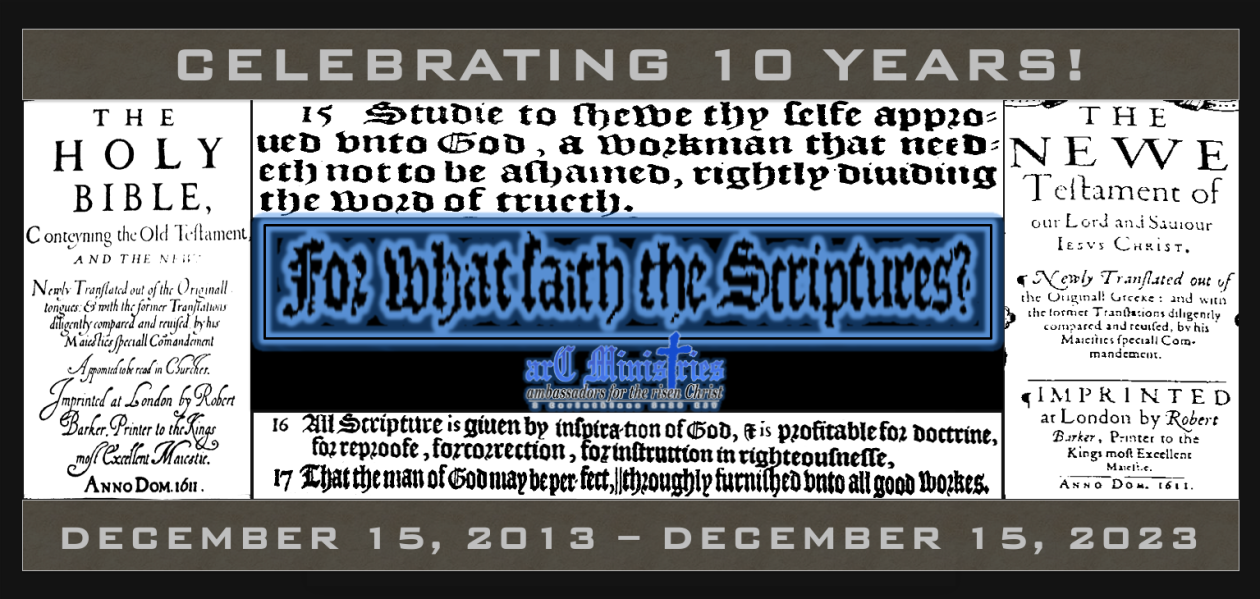
When Paul urged Timothy, “Study to shew thyself approved unto God, a workman that needeth not to be ashamed, rightly dividing the word of truth” (2 Timothy 2:15), what he meant was that Timothy was to recognize divisions in the Bible that God had already made. Timothy was to “rightly divide the word of truth.” Essentially, Timothy was to understand that the resurrected, ascended, and glorified Lord Jesus Christ had given the Apostle Paul a special ministry and message, and he was to make sure that he did not confuse Paul with other divine spokesmen in Scripture, that he not confuse Paul’s writings with other Bible writers (as those were doing in verses 17-18, and are still doing today in much of Christendom). Paul was the man whom God sent to speak to us Gentiles (Romans 11:13). In Paul’s epistles alone, we find our doctrine, duty, walk, and destiny. All of the Bible is for us, but not all of the Bible is to us and not all of the Bible is about us (remember, most of the Bible is written to and is about the nation Israel, not us). We do not go to Israel’s program and claim Israel’s verses. God’s Word to us is Paul’s epistles, Romans through Philemon. Paul is our apostle. Paul was sent to us Gentiles. We follow God’s design for Christian edification, and we seek God’s approval, not man’s approval (2 Timothy 2:15).

We study all of the Bible, Genesis through Revelation, but we follow the design of Christian edification as laid out in Romans 16:25-26. If we refuse to follow the dispensational layout of Scripture, and most people do refuse it, then we will be going against what God is doing today, and our Christian lives will be in shambles (which is why Christendom is in such pitiful shape!).

DAILY BIBLE READING IN LIGHT OF THE THREE-FOLD EDIFICATION

You should make it a habit to read your King James Bible daily. You may want to read a few verses, or maybe a chapter—the number of verses is up to you but, in light of Romans 16:25-26, this is how I would recommend that you should read your Bible for the first time:

  1. Read through the book of Romans (16 chapters), and then proceed to read through to Philemon (1 Corinthians to Philemon are the 12 books after Romans)—the 13 books of Romans through Philemon are frequently called the “Pauline epistles.” Actually, if you read three or four chapters daily, you could read through Paul’s epistles in about three weeks.
  2. After you read Romans through Philemon, start in Matthew and read all the way through to the Bible’s last book, the Revelation—the 27 books of Matthew through the Revelation are commonly called the “New Testament Scriptures.” If you read three or four chapters a day, you could read through the New Testament in about three months.
  3. Once you reach the Revelation, then you can begin in Genesis, the Bible’s first book, and read all the way through to Malachi (the 39 books, Genesis through Malachi, are commonly called the “Old Testament Scriptures”). Then, read from Matthew to the Revelation, the Bible’s last book (for a total of 66 books). (NOTE: Depending on your reading speed, it may take you a year or two in order to do all three steps, and that is fine. The goal is not to hurry through to see how much you can read; your purpose is to at least expose yourself to God’s Word, and the “general feel” of the text will gradually become more pronounced as you read it through every year. The more you read the Scriptures, the more they will make sense to you.)

After you have completed steps 1-3, get in the habit of reading your Bible through at least once a year (Genesis through Revelation). In addition to reading, you should study it, comparing spiritual things with spiritual, comparing Scripture with Scripture. Studying is much more intensive than just reading; studying is comparing or contrasting one verse with another verse, usually concerning a particular theme/issue/doctrine. A Strong’s Concordance can be useful in this regard. While they are interesting, studies in Greek and Hebrew will not benefit those new to the Bible; please guard yourself against those who stress the original Bible languages to the extent that they change the English text that you can read for yourself. You actually do not need to know anything about Greek or Hebrew to understand the Bible—many times, such knowledge is a hindrance to Bible comprehension.

TWO BIBLE PASSAGES WORTH MEMORIZING FIRST

As a side-note, any new Christians, or anyone new to the Bible, should memorize the Gospel of the Grace of God: “How that Christ died for our sins according to the scriptures; and that he was buried, and that he rose again the third day according to the scriptures” (1 Corinthians 15:3-4). The average professing Christian cannot adequately or clearly quote this Gospel message, and it is so sad it is beyond words. If you remember nothing else from the Bible, please remember 1 Corinthians 15:3-4. It is the greatest passage in all of Scripture! It is the greatest message the God of the Bible has ever told all of mankind!

Romans 5:1-11, as it is written in the King James Bible, should also be memorized as soon as possible: “[1] Therefore being justified by faith, we have peace with God through our Lord Jesus Christ: [2] By whom also we have access by faith into this grace wherein we stand, and rejoice in hope of the glory of God. [3] And not only so, but we glory in tribulations also: knowing that tribulation worketh patience; [4] And patience, experience; and experience, hope: [5] And hope maketh not ashamed; because the love of God is shed abroad in our hearts by the Holy Ghost which is given unto us. [6] For when we were yet without strength, in due time Christ died for the ungodly. [7] For scarcely for a righteous man will one die: yet peradventure for a good man some would even dare to die. [8] But God commendeth his love toward us, in that, while we were yet sinners, Christ died for us. [9] Much more then, being now justified by his blood, we shall be saved from wrath through him. [10] For if, when we were enemies, we were reconciled to God by the death of his Son, much more, being reconciled, we shall be saved by his life. [11] And not only so, but we also joy in God through our Lord Jesus Christ, by whom we have now received the atonement.” Friend, one day in the future, you will learn just how helpful this passage will be in your life!

A FEW WORDS OF ENCOURAGEMENT

  • Whatever you do, please do not begin reading in, or trying to understand the Bible by using, the book of Acts. Acts can be a very confusing book if not understood dispensationally. Acts is a transitional book that documents God turning away from Israel (Peter and the 11’s ministry) and Him dealing with Gentiles/non-Jews (Paul’s ministry). Like I suggested earlier, before reading Acts, read Paul’s epistles first and then read the New Testament (Acts is the fifth book of the New Testament Scriptures).
  • Bear in mind that you will not understand everything in the Old Testament. Do not grow weary when you read through extensive genealogical records like those in the first 10 chapters of Genesis, or the first 11 chapters of 1 Chronicles, or Matthew chapter 1, or Luke chapter 3. Do not get wrapped up in trying to comprehend all of the prophetic utterances like those in the books of Daniel and the Revelation—these are not written for our time or circumstances anyway, so we are not meant to understand them thoroughly. We can and should study them when we progress in spiritual maturity, but prophecy is usually very cumbersome for new believers or anyone new to Scripture.
  • Lastly, we have a Bible question-and-answer website that you can consult or use to submit Bible questions to me. Whatever we can do to further your understanding of the Holy Bible, please let us know. You can check out https://forwhatsaiththescriptures.wordpress.com for more information.

SOME FINAL WORDS – DO WE STUDY ONLY PAUL’S EPISTLES? (NO!)

“All scripture is given by inspiration of God” (2 Timothy 3:16). All of the Bible is God’s Word, so we study all 66 books of the King James Bible (Genesis to Revelation). But, unlike most churches and professing Christians, we study the entire Bible according to the “revelation of the mystery,” (in light of the Pauline epistles, Romans through Philemon). When studying a particular Bible passage, you first need to establish the following, in this order:

  1. who is writing/speaking,
  2. to whom are they writing, and
  3. what are they writing.

Again, keep in mind that Paul’s epistles of Romans through Philemon are what God has to say to you, and the rest of the Bible deals with another program, Israel’s program. If Paul does not instruct you to do it, then God does not expect you to practice it in your life.

While I will conclude this study for sake of brevity (for fear of not being able to do justice to related topics I would like to address here), I do highly recommend that you see our three related Bible studies linked below. They will expand on issues we have only briefly discussed here.

Please see our Bible timelines, a printable black-and-white version and a color version, as well as our One-Year Bible Reading Schedule. You will find all of these resources on our Bible study-aids page.

“Thy word is a lamp unto my feet, and a light unto my path” (Psalm 119:105).

“Man shall not live by bread alone, but by every word that proceedeth out of the mouth of God” (Matthew 4:4).

Also see:
» What is dispensational Bible study anyway?
» Why can I not get anything out of the Bible?
» Does God intervene in my life? If so, how?

Why can I not get anything out of the Bible?

WHY CAN I NOT GET ANYTHING OUT OF THE BIBLE WHEN I READ IT?

by Shawn Brasseaux

I try to read the Bible, but I get little to nothing out of what I read. What is the problem?

My heart truly goes out to people who are confused and burdened regarding Bible study. Friend, you are not alone—millions upon millions upon millions of people have experienced what you are undergoing, and millions upon millions upon millions are still experiencing it. I have been there, I know your distress, I have found the answers that you seek, and I would enjoy providing you with the three keys to Bible clarity. Dear reader, there is certainly hope for you and everyone else confused regarding the Holy Scriptures. We want to help you understand and enjoy the Holy Bible; in this study, we will discuss the three top reasons why people do not understand the Bible. This is a rather extensive and intensive study, but well worth considering.


1. DO YOU HAVE THE HOLY SPIRIT?

We read in 2 Timothy 3:16: “All scripture is given by inspiration of God….”

The Bible says in 2 Peter 1:19-21: “[19] We have also a more sure word of prophecy; whereunto ye do well that ye take heed, as unto a light that shineth in a dark place, until the day dawn, and the day star arise in your hearts: [20] Knowing this first, that no prophecy of the scripture is of any private interpretation. [21] For the prophecy came not in old time by the will of man: but holy men of God spake as they were moved by the Holy Ghost.”

God the Holy Ghost wrote the Holy Scriptures. If we are to understand the Book that the Holy Ghost wrote, it is only logical that we must have the indwelling Holy Ghost. Many people who attempt to study the Bible are lost, they are not saved unto eternal life and they do not have the indwelling Holy Spirit. Thus, the Bible is “foolishness” to them; God’s Word never makes sense without the teaching ministry of the Holy Spirit. This is why easier-to-read translations are so popular; they are an attempt to bypass the Holy Spirit’s teaching ministry. We need more than the spirit of man if we are to understand the Bible. To understand Scripture, we need more than scientific investigation, we need more than religious tradition, and we need more than human intuition.

Consider 1 Corinthians 2:9-14: “[9] But as it is written, Eye hath not seen, nor ear heard, neither have entered into the heart of man, the things which God hath prepared for them that love him. [10] But God hath revealed them unto us by his Spirit: for the Spirit searcheth all things, yea, the deep things of God. [11] For what man knoweth the things of a man, save the spirit of man which is in him? even so the things of God knoweth no man, but the Spirit of God. [12] Now we have received, not the spirit of the world, but the spirit which is of God; that we might know the things that are freely given to us of God. [13] Which things also we speak, not in the words which man’s wisdom teacheth, but which the Holy Ghost teacheth; comparing spiritual things with spiritual. [14] But the natural man receiveth not the things of the Spirit of God: for they are foolishness unto him: neither can he know them, because they are spiritually discerned.”

How do we get the indwelling Holy Spirit? Ephesians 1:12-13 tells us: “[12] That we should be to the praise of his glory, who first trusted in Christ. [13] In whom ye also trusted, after that ye heard the word of truth, the gospel of your salvation: in whom also after that ye believed, ye were sealed with that holy Spirit of promise….” We must trust Jesus Christ—rely exclusively on His death, burial, and resurrection as sufficient payment for our sins. This is the Gospel of the Grace of God, Paul’s Gospel, of 1 Corinthians 15:3-4: “[3] For I delivered unto you first of all that which I also received, how that Christ died for our sins according to the scriptures; [4] And that he was buried, and that he rose again the third day according to the scriptures.”

If you have just trusted Jesus Christ alone as your personal Saviour, or you have trusted Him sometime in the past, you are indeed saved unto eternal life, and thus you may proceed to our second section.


2. DO YOU HAVE THE RIGHT BIBLE?

Just as every book in the world is not the Book that God has written, every “Bible” is not the book that God has written; in this day and age, the average church member—or even average priest or pastor—cannot identify what is the Bible and what is not. The aforementioned people who did not have the Holy Spirit, they produced perverted Bible manuscripts, translated them, and produced even more corrupt translations (albeit operating under the impression that those manuscripts were more reliable and their translations were easier-to-read and therefore trustworthy). Even in Bible days, there were people counterfeiting the Word of God. Satan is the master counterfeiter, so may we always be on guard against counterfeit Bible versions—even more so 20 centuries later!

The Apostle Paul wrote in 2 Corinthians 2:17: “For we are not as many, which corrupt the word of God: but as of sincerity, but as of God, in the sight of God speak we in Christ.” We find in 2 Thessalonians 2:2 a reference to a counterfeit Bible manuscript, one that appeared to be from the Apostle Paul and his ministry coworkers. This false manuscript with false doctrine had troubled the minds of the Christians in Thessalonica: “That ye be not soon shaken in mind, or be troubled, neither by spirit, nor by word, nor by letter as from us, as that the day of Christ is at hand.” The Apostle Peter warned that some individuals were “unlearned and unstable” and that they would “wrest… the other scriptures, unto their own destruction” (2 Peter 3:16). They would not only twist Paul’s epistles, but all of God’s Word, and distort the verses to make them say what they wanted them to say. (Does that sound familiar or what?)

Even in the Prophet Jeremiah’s day, some 600 years before Christ, we read about false prophets twisting God’s Word, preaching lies in JEHOVAH’S name to Israel: “And the burden of the LORD shall ye mention no more: for every man’s word shall be his burden; for ye have perverted the words of the living God, of the LORD of hosts our God (Jeremiah 23:36). This entire chapter is an eye-opening warning about counterfeit “Bible prophets” and “ministers.”

The Apostle Peter summarized a warning that is true regardless of the dispensational setting. Just as there are people from the Lord Jesus Christ spreading His Word, there are counterfeit Christians spreading a damnable message: “[1:19] We have also a more sure word of prophecy; whereunto ye do well that ye take heed, as unto a light that shineth in a dark place, until the day dawn, and the day star arise in your hearts: [1:20] Knowing this first, that no prophecy of the scripture is of any private interpretation. [1:21] For the prophecy came not in old time by the will of man: but holy men of God spake as they were moved by the Holy Ghost. [2:1] But there were false prophets also among the people, even as there shall be false teachers among you, who privily shall bring in damnable heresies, even denying the Lord that bought them, and bring upon themselves swift destruction. [2:2] And many shall follow their pernicious ways; by reason of whom the way of truth shall be evil spoken of. [2:3] And through covetousness shall they with feigned words make merchandise of you: whose judgment now of a long time lingereth not, and their damnation slumbereth not” (2 Peter 1:19–2:3).

As an English-speaking person, God’s preserved Word for you is the Authorized Version King James Bible. Use it, and use it alone, in your personal Bible study. The 400-year-old King James Bible—not the New King James Version—proves itself to be authoritative and trustworthy. The modern versions, however, demonstrate themselves to be unreliable; we should not use any book we cannot trust. They have varying degrees of interpretation built right into the translated text, and hundreds if not thousands of cross-references have been lost because of such shoddy Bible-handling. They have been produced by ecumenical bodies, groups of scholars from various denominations, scholars who are still cooperating to advance denominational doctrine instead of the unadulterated Word. In this day and age of itching ears and much false doctrine, we would be insane to believe that the new “bible” versions are dependable!

If you are using a King James Bible at this point, then a faulty Bible translation is not your problem. Please proceed to our third section.


3. DO YOU HAVE THE RIGHT STUDY SYSTEM?

A. LITERAL (UNLESS CONTEXT INDICATES OTHERWISE)

Concerning Bible study, the following makes sense: “When the literal sense makes sense, seek no other sense.” You should let the Bible text tell you whether a passage/verse/word is literal or figurative. If the context says that it is a parable, then it is a parable. If the context says that it is an allegory, then it is an allegory. Some Bible verses contain sarcasm. Some verses contain figures of speech. These non-literal exceptions are most often apparent. Even when the Bible uses symbolic language—metaphor, simile, allegory, parable, et cetera—there is a literal truth associated with it. Nothing in the Bible is there to take up space; every word is important (Deuteronomy 8:3; Matthew 4:4; Luke 4:4). The normal sense of the Bible is literal. To spiritualize a passage is to tell spiritual lies because you do not have spiritual eyes; the Bible says what it means and it means what it says. The Bible is not hard to understand; it is hard to believe!

The Lord Jesus Christ believed the Bible literally. He taught a literal, physical, visible Adam and Eve who were literally, physically, and visibly created and married by God (Mark 10:6-8; cf. Genesis 1:27; Genesis 2:18,21-25). Jesus literally believed He was a descendant of King David, implying David was a real man who had an actual bloodline (Matthew 22:41-46). The Lord believed in a literal interpretation of Daniel’s prophecy (Matthew 24:15ff.; Mark 13:14ff.; Daniel 9:26-27; Daniel 11:31). The Lord Jesus believed in a literal Great Flood of Noah’s day (Matthew 24:37-39; Luke 17:26-27; cf. Genesis chapters 6–8). The Lord Jesus believed in a literal man named Lot, Lot’s literal wife, and God’s literal destruction of Sodom and Gomorrah with literal fire and brimstone (Luke 17:28-29,32; cf. Genesis 19:24-25). Jesus believed there was a literal man named David who ate the shewbread with his men (Matthew 12:3-4; Luke 6:3-4; cf. 1 Samuel 21:1-6). Jesus believed in literal, physical, visible men such as Abraham, Isaac, and Jacob (Matthew 22:32)—He believed God literally appeared to Moses in the burning bush too (Exodus 3:6). He believed there was a real man named Abel who was actually killed by his evil, unbelieving brother Cain (Matthew 23:35; Genesis 4:8,11). He believed that there was a literal man, “Zacharias son of Barachias,” who was actually murdered in the Temple complex as the Old Testament teaches (Matthew 23:35; cf. 2 Chronicles 24:21). Jesus cried, “I thirst,” so He could literally fulfill Psalm 69:21 (John 19:28). He affirmed that Satan literally fell from heaven (Luke 10:18), exactly what Isaiah 14:12-17 and Ezekiel 28:11-19 teach. Jesus said He came to literally fulfill Isaiah 61:1-2 (cf. Luke 4:16-21). The Lord Jesus really believed that actual bread fell from heaven for Israel to physically eat under Moses’ leadership (John 6:49; cf. Exodus 16:14-36).

The Apostle Paul believed the Bible literally. He understood a literal, physical, visible Adam and Eve were married by God (Ephesians 5:29-33; cf. Genesis 2:18,21-25). He believed in a literal woman named Eve who Satan actually deceived, and a physical man (Adam) whom Satan did not deceive (2 Corinthians 11:3-4; 1 Timothy 2:11-15; cf. Genesis 3:1-24). Paul believed there was a literal curse placed on creation in response to man’s fall into sin (Romans 5:12; Romans 8:18-25; Genesis 3:16-19). The Apostle believed that Adam was literally created from the dust of the earth (1 Corinthians 15:47; cf. Genesis 2:7; Genesis 3:19). Paul believed in a literal man named Moses whom God used to ordain a most strict religious system using tables of physical stone (2 Corinthians 3:7-14; cf. Exodus chapters 32-34). He believed that there was a literal Adam (“one blood”) from whom all nations of people descended (Acts 17:26), exactly what Genesis 1:28 said when God commanded Adam and Eve to literally reproduce. Paul believed that God allotted the literal, real-estate boundaries of nations (Acts 17:26), implying a literal interpretation of Genesis chapters 10 and 11 when God scattered the idolaters from the Tower of Babel. Paul believed in a literal, physical, visible Ishmael persecuting a literal, physical, visible Isaac (Genesis 21:9), pointing out that literal, physical, visible unbelievers attack literal, physical, visible believers today (Galatians 4:29). Paul believed in literal, physical people such as Abraham, Isaac, Rebekah, Jacob and Esau whose descendants are the Jews (Romans 9:7-13)—these individuals are referenced throughout the book of Genesis. Paul believed in a literal Pharaoh who literally held Israel captive as slaves in literal Egypt (Romans 9:17; cf. Exodus 9:16). Paul interpreted Israel’s future restoration as literal (Romans 11:26-27; cf. Isaiah 59:20-21; Jeremiah 31:31-34). Paul understood everyone standing before God in judgment (Isaiah 45:23) is a literal fact to be accomplished one day (Romans 14:11-12).

The Apostle Peter believed the Bible literally. He referred to the Great Flood of Noah’s day as though it were a literal, historical fact (1 Peter 3:19-21; 2 Peter 2:5; 2 Peter 3:3-6; cf. Genesis chapters 6-8)—Peter argued that similar judgment from God (although fire) will come on the world in the future. Peter believed in an historical man named Lot, a man who literally escaped God’s literal wrath on Sodom and Gomorrah (2 Peter 2:6-9). Peter believed the Word of God would literally exist forever (1 Peter 1:25; cf. Isaiah 40:6-8). The Apostle believed Sodom and Gomorrah were literally overthrown with fire and brimstone as recorded in Genesis chapter 19 (2 Peter 2:6). Peter referred to Abraham and Sarah as literal, physical people who were husband and wife (1 Peter 3:5-6; cf. Genesis 18:12). The Apostle believed “Balaam the son of Bosor” was a literal, physical person (2 Peter 2:15; cf. Numbers chapters 22-24).

The Apostle John believed the Bible literally. While he does not refer to but one historical Old Testament account in his writings, he does admit that he believed there were literal figures Cain and Abel, Cain physically and visibly killing his brother Abel, just as Moses recorded in Genesis (1 John 3:12-13; cf. Genesis 4:8-11). John argued that unbelievers would kill believers because of the never-ending conflict between God’s people and Satan’s people.

The Apostle James believed the Bible literally. He believed the book of Genesis literally when it says that Abraham offered Isaac his son on the altar (James 2:21-23; cf. Genesis chapter 22). James indicated that Rahab the harlot was an historical character, who actually hid the Jewish spies in Jericho, just as the book of Joshua depicts (James 2:25; cf. Joshua chapter 2). He referenced Job as though he were an historical character (James 5:11), whose literal sufferings portray Israel’s future dire physical circumstances. James believed that the Prophet Elias (Elijah) prayed to JEHOVAH and literally caused rain to cease in Israel for three-and-one-half years, just as 1 Kings says (James 5:17; 1 Kings 17:1-2).

The writer of the book of Hebrews believed the Bible literally. It is unknown whom God used to pen the book of Hebrews. Regardless, this individual believed the Old Testament characters were literal, physical, visible, historical individuals—not mere characters in nonfiction works, fairytales, or the like. Hebrews chapter 11 makes references to Abel, Enoch, Noah, Abraham, Isaac, Jacob, Sara, Joseph, Moses, Israelites who left Egypt, Rahab, Gideon, Barak, Samson, Jephthae, David, Samuel, the prophets, and others. These were all historical people who endured physical persecution for believing and following the God of the Bible, the God of Israel, the God of creation.

B. DISPENSATIONAL

There are many methods and systems of Bible interpretation (also known as, “Bible hermeneutics”). For example, systematic theology studies Bible topics in a topical fashion: theology (the study of God), angelology (the study of angels), eschatology (the study of the end times / prophecy), ecclesiology (the study of the church), anthropology (the study of man), soteriology (the study of salvation), et cetera. This is all well and good, but this is not how the Bible presents these doctrines (the contexts of these verses are ignored, and they are all blended).

Rather than following the system of Dr. Strong, Dr. Scofield, Dr. Ryrie, or any other theologian, seminary professor, or Bible “scholar,” we simply allow the Holy Spirit—the Author of the Bible—to show us how He has designed it. When we stand before God in judgment one day, He will use His standard of Bible interpretation; in Heaven, God Almighty will not refer to man-made religious systems and theological books in order to gauge what teaching is right and what teaching is wrong. Confusion arises when we pick and choose a man-made system to follow, for every man-made system of Bible study is different from every other. However, much of the confusion will disappear if we simply use the method of Bible study that God Himself has ordained and laid out in His Word. We would all be using one and the same system for Bible study, and this would avoid the formation of factions, denominations, schisms, cults, et cetera.

The only verse in the Bible that tells us to “study” the Bible also tells us how to study it. We read in 2 Timothy 2:15: “Study to shew thyself approved unto God, a workman that needeth not to be ashamed, rightly dividing the word of truth.” We are seeking God’s approval—not a church’s approval, a seminarian’s approval, a minister’s approval, a family member’s approval, a friend’s approval, or anyone else’s approval. If our Christian lives are to be pleasing in God’s sight, we must “study… rightly dividing the word of truth.” But, what exactly does this mean? We need to search Paul’s epistles to discover the answer.

Ephesians 2:11-13 sheds light on 2 Timothy 2:15: “[11] Wherefore remember, that ye being in time past Gentiles in the flesh, who are called Uncircumcision by that which is called the Circumcision in the flesh made by hands; [12] That at that time ye were without Christ, being aliens from the commonwealth of Israel, and strangers from the covenants of promise, having no hope, and without God in the world: [13] But now in Christ Jesus ye who sometimes were far off are made nigh by the blood of Christ.”

We see two references to time in the above passage: “time past” and “but now.” At one time, we Gentiles were “without Christ,” we were “aliens from the commonwealth of Israel,” we were “strangers from the covenants of promise,” we had “no hope,” and we were “without God in the world.” God dealt with the nation Israel, and if a non-Jew (Gentile) ancestor of ours wanted a relationship with the God of the Bible, the God of Israel, that Gentile had to approach God through Israel. Jesus Christ’s ministry was confined to the nation Israel (Matthew 10:5-7; Matthew 15:24; John 4:22; Acts 2:22; Romans 15:8)—this is why Scripture says we Gentiles were “without Christ” (Ephesians 2:12; cf. Romans 9:4-5).

Ephesians 2:13 is a contrary thought, the opposite of what we read in the previous two verses. “In Christ Jesus,” we who were (past tense) “far off” from God are now (present tense) made near to Him “by the blood of Christ.” What a complete change in the way God deals with mankind, and we have to want to miss it not to see that dispensational change! As God Himself declared first by and through the Apostle Paul, through Jesus Christ’s shed blood (His finished crosswork at Calvary), we Gentiles can now approach God the Father, without the nation Israel. In fact, Israel is fallen, and without Israel and her earthly kingdom, God is reaching and saving Gentiles.

The Holy Spirit tells us in Romans 11:11-13: “[11] I say then, Have they stumbled that they should fall? God forbid: but rather through their fall salvation is come unto the Gentiles, for to provoke them to jealousy. [12] Now if the fall of them be the riches of the world, and the diminishing of them the riches of the Gentiles; how much more their fulness? [13] For I speak to you Gentiles, inasmuch as I am the apostle of the Gentiles, I magnify mine office.”

Why God wanted to save Gentiles through Israel and her program, and why God is now saving Gentiles without Israel and her program, is a fascinating story we must take time here to briefly summarize for you.

The first verse in the Bible is very clear that God deals with creation on the basis of two realms: “In the beginning God created the heaven and the earth” (Genesis 1:1). Notice how the Holy Spirit was very specific in the wording. Rather than saying, “God created the universe,” the Scriptures say, “God created the heaven and the earth.” The two-fold division in God’s Word is already apparent… we learn about right division in the very first verse of the Bible!

Regarding God’s original purpose in the creation of the heaven and the earth, we learn in Ephesians 1:9-10: “[9] [God the Father] Having made known unto us the mystery of his will, according to his good pleasure which he hath purposed in himself: [10] That in the dispensation of the fulness of times he might gather together in one all things in Christ, both which are in heaven, and which are on earth; even in him.”

Before creation ever was, God the Father wanted to unite all of the governmental offices of heaven and earth (see Colossians 1:16-20) under the headship, the leadership, of His Son Jesus Christ. Even today, God the Father wants all of creation to glorify the Lord Jesus Christ. To bring about this purpose, Father God has one program—one system of operation—for heaven, and another completely different program—another system of operation—for earth. Both programs operate in their respective realms to accomplish the overall goal: make Jesus Christ head of all of the governments in heaven and earth, to give Him preeminence in both realms of creation. But, these two programs must be rightly divided if they are to make sense (to combine God’s purpose and plan for heaven and His purpose and plan for earth, is to bring unanswerable confusion, is to bring about the sad state of affairs in Christendom today).

PROPHECY. The program that God uses to magnify His Son in the earth is called the prophetic program, for it contains information/doctrine that was prophesied, or spoken about, since He placed man (Adam) on earth. Notice what the Apostle Peter preached: “[Jesus Christ] Whom the heaven must receive until the times of restitution of all things, which God hath spoken by the mouth of all his holy prophets since the world began(Acts 3:21). From the beginning of creation, God revealed to mankind a plan to have Jesus Christ reign on planet earth. This information is found in the Bible books of Genesis through Malachi, Matthew through John, Acts chapters 1-8, and Hebrews through Revelation. The agency (group of believers) whom God will use to magnify His Son forever in the earth is the nation Israel (Exodus 19:5-6; Psalm 37:11; Matthew 5:5; Luke 22:29-30; Revelation 5:10). Law is the operating system for the prophetic program (Matthew 5:17-19). The Apostle Peter and the other 11 apostles of Israel are the divinely-ordained human leaders in this program (Matthew 16:16-19; Matthew 19:27-28; Luke 22:30; Galatians 2:7,9).

MYSTERY. The program that God uses to magnify His Son in the heavens is called the mystery program, for it contains information/doctrine that was kept secret, or not spoken about, since He placed man (Adam) on earth. Notice what the Apostle Paul wrote: “Now to him [God the Father] that is of power to stablish you according to my gospel, and the preaching of Jesus Christ, according to the revelation of the mystery, which was kept secret since the world began, [26] But now is made manifest…” (Romans 16:25-26). From the beginning of creation, God kept secret (kept it a mystery) a plan to have Jesus Christ reign in the heavenly places. This information is found in the Bible books known as “Paul’s epistles,” Romans through Philemon. The agency (group of believers) whom God will use to magnify His Son forever in the heavens is the Church the Body of Christ (Ephesians 1:3; Ephesians 2:6-7; Philippians 3:20; 2 Timothy 4:18). Grace is the operating system for the mystery program (Romans 6:14-15). The Apostle Paul is the divinely-ordained human leader in this program (Romans 11:13; Romans 15:16; Galatians 2:7,9; 1 Timothy 1:15-16).


CONCLUSION

In conclusion, we allow the indwelling Holy Spirit to teach us His Word. We read verses in the King James Bible and compare them with other verses in the King James Bible, and the verses will interpret one another. Unless the context says otherwise, the verse/passage is literal. We use the Bible dispensationally, understanding that God says different things to different people in His Word at different time periods. Paul’s epistles, Romans through Philemon, describe what God is doing today, so this is God’s Word to and about you. Study all of the Bible, Genesis through Revelation, for it is all for your learning (Romans 15:4), but remember that not all of the Bible is to or about you.

When studying a particular Bible passage, you first need to establish the following, in this order:

  1. who is writing/speaking,
  2. to whom are they writing, and
  3. what are they writing.

Oftentimes, people ignore #1 and #2 and just focus on #3. We cannot grab just any Bible verse and apply it to us. Paul’s epistles, Romans through Philemon, are written to us Gentiles and about us Gentiles. If you follow these simple keys to Bible understanding, you will understand the Bible.

Just as the Lord Jesus Christ “opened… their understanding, that they might understand the scriptures” (Luke 24:45), and “expounded unto them in all the scriptures the things concerning himself” (verse 27), so He will explain the Scriptures to you if you allow Him. If you have the indwelling Holy Spirit, if you have the King James Bible, and you use dispensational Bible study, the Bible will literally become an “open book.” You will enjoy it, cherish it, esteem it, love it, more and more each day. To the believer, Paul wrote the following:

Ephesians 3:4: “Whereby, when ye read, ye may understand my knowledge in the mystery of Christ)”

Ephesians 3:16: “That he would grant you, according to the riches of his glory, to be strengthened with might by his Spirit in the inner man;”

2 Timothy 2:7: “Consider what I say; and the Lord give thee understanding in all things.”

When we Christians read God’s Word (King James Bible), and pay particular attention to what God says through Paul (Ephesians 3:4; 2 Timothy 2:7), God the Holy Spirit (Ephesians 3:16) will strengthen us inside, in our soul and spirit. He will then use that doctrine that we believe to work in us: “For this cause also thank we God without ceasing, because, when ye received the word of God which ye heard of us, ye received it not as the word of men, but as it is in truth, the word of God, which effectually worketh also in you that believe” (1 Thessalonians 2:13).

“So they read in the book in the law of God distinctly, and gave the sense, and caused them to understand the reading” (Nehemiah 8:8).

Also see:
» I am new to the Bible, so where should I begin? (LINK TEMPORARILY UNAVAILABLE)
» Does doctrine really matter? (LINK TEMPORARILY UNAVAILABLE)
» Does God intervene in my life? (LINK TEMPORARILY UNAVAILABLE)

Should the King James’ term “Christ” actually be “Lord” in 2 Thessalonians 2:2?

SHOULD THE KING JAMES TERM CHRIST REALLY BE LORD IN 2 THESSALONIANS 2:2?

by Shawn Brasseaux

King James Bible critics invariably hone in on the term “Christ” in 2 Thessalonians 2:2 and gleefully shout out, “Mistranslation—it should be ‘Lord’ not ‘Christ!’” Is there any merit in this their observation, or is it just idle speculation worth ignoring? Before we come to a conclusion, let us investigate the verse in question, being especially careful to note the context. Maybe… just maybe… we will learn that we have much more to learn from God’s Word than we think we know (1 Corinthians 8:2).

Frankly, there is much arrogance—and much ignorance—in the realm of Bible “scholarship.” Mortal men educated in schools of mortal men sit on self-constructed thrones and make themselves out to be gods. Yes, they sat in Hebrew, Greek, Latin, and church tradition and history classes, but those credentials alone do not make them Bible believers and those achievements do not automatically make them sound Bible authorities. There are millions upon millions of people who read and speak Hebrew, Greek, and Latin, but they reject the Bible in all matters of faith and practice—do you actually want them to tell you what the Bible “really” says?

Beloved, I have personally met seminary preachers and priests, I have conversed with them in person and/or email, I have read their works, I have watched their television programs, and I have sat in their church buildings and lectures. I can report in complete sincerity that the vast majority of these alleged Bible “scholars” are so perverted doctrinally it is beyond fathoming. Seminary is a nursery for unbelief and a cemetery for the Bible! They laughed at the Bible, they questioned the Bible, and they ignored the Bible. And, yes, that is applicable to Roman Catholic and Protestant seminary graduates alike. Indeed, we agree with our Lord Jesus Christ who prayed: “I thank thee, O Father, Lord of heaven and earth, because thou hast hid these things from the wise and the prudent, and hast revealed them unto babes. Even so, Father: for so it seemed good in thy sight” (Matthew 11:25-26). “For the wisdom of this world is foolishness with God… The Lord knoweth the thoughts of the wise, that they are vain [empty, worthless]” (1 Corinthians 3:19-20).

In fact, the “scholarly” elite dares not to submit to God’s Book, and they do everything possible to cause you to doubt it and trust them. Israel’s religious leaders did it in Jesus’ day, and religious leaders around the world still do it today. They want the authority; they want the preeminence Almighty God and His Word alone deserve. Man is sinful, and because there are many lost people in the realms of Bible scholarship, they want to be their own god, their own authority. Without so much as a blush, they quickly lunge at the Bible text and butcher it with the scholar’s scalpel, changing the precious words of God so those divine utterances make sense in their fallen minds. They throw out a verse here, they make up a new verse there, they change this word and that word, they toss out two 12-verse passages, they water down innumerable verses, while the average Christian (conditioned) sits and relaxes while he or she lets the “scholars” adjust the Bible text to make it understandable. We would hate to be in their shoes when they stand before a holy, righteous God and explain to Him why they corrupted His Word, why they thought their puny minds were smarter than His!

Okay, now, with that said, we can examine the pompous attitude toward the King James’ rendering of 2 Thessalonians 2:2. (Remember our comments about people who believe they are smarter than God?) The following quote from a bygone commentator summarizes the view that is still prevalent among Bible “scholars” today:

“Verse 2 closes with the words, ‘…As that the day of Christ is at hand.’ Greek authorities assure us that this last statement is faulty insofar as the Greek is concerned. It should read, ‘…Supposing that the Day of the Lord is upon us.’ ‘The Day of Christ’ is definitely not intended here, but ‘the Day of the Lord.’ … It is very unfortunate that this verse in II Thessalonians is mistranslated in our King James Bible. The Word ‘Christ’ should be ‘Lord,’ and in this case the mistranslation changes the entire meaning of the event Paul is describing.”

Our brief answer to the above accusation, and rank vilification of our 1611 translators, is as follows: “If the King James’ term ‘Christ’ in 2 Thessalonians 2:2 ‘changes the entire meaning of the event Paul is describing,’ it is equally true that replacing that term with ‘Lord’ could, hypothetically, also change the entire meaning of the event Paul is describing. There is a major disagreement whether to use ‘Christ’ or ‘Lord.’ Obviously, it is not a trivial issue; it cannot be ignored and it cannot be taken lightly. Questioning the phraseology of God’s Holy Word is, and I say this advisedly, heretical; either the authority is in the Bible, or it is in the Greek scholars. Moreover, if ‘Christ’ is not a mistranslation in our King James in 2 Thessalonians 2:2, then the critics’ changing of the text is literally pointless; in fact, if their change is unnecessary, and we are persuaded it is, to change it to ‘Lord’ is to miss the point of the often-ridiculed King James’ word ‘Christ.’” (Our Bible-believing position receives fuller treatment in our extended answer below.)

Let us look at 2 Thessalonians chapter 2: “[1] Now we beseech you, brethren, by the coming of our Lord Jesus Christ, and by our gathering together unto him, [2] That ye be not soon shaken in mind, or be troubled, neither by spirit, nor by word, nor by letter as from us, as that the day of Christ is at hand. [3] Let no man deceive you by any means: for that day shall not come, except there come a falling away first, and that man of sin be revealed, the son of perdition; [4] Who opposeth and exalteth himself above all that is called God, or that is worshipped; so that he as God sitteth in the temple of God, shewing himself that he is God.”

Absolutely, 2 Thessalonians 2:3ff. describes “the day of the LORD;” as a King James Bible believer, I fully understand that. In that passage (which actually continues down to verse 12), we see the appearance of the Antichrist—his career from start to finish (verses 3-8), complete with all of his blasphemous activities and deceptive doctrines (verses 4-12), and his defeat by Jesus Christ at His Second Coming (verse 8). The phrase “day of the LORD” first appeared in Isaiah 2:12, and it is found throughout the Old Testament Scriptures (Isaiah 13:6,9; Isaiah 34:8; Jeremiah 46:10; Lamentations 2:22; Ezekiel 13:5; Ezekiel 30:3; Joel 1:15; Joel 2:1,11,31; Joel 3:14; Amos 5:18,20; Obadiah 15; Zephaniah 1:7-8,14; Zechariah 14:1; Malachi 4:5; Acts 2:20; 2 Peter 3:10). Even in the New Testament (1 Thessalonians 5:2; 2 Peter 3:10) it refers to the time from the Babylonian captivity about 600 B.C. all the way until the Apostle Paul’s ministry, skipping our dispensation, and encompassing the seven-year Tribulation and the Millennial Reign of Jesus Christ.

Here is where we get to the most critical part, so please pay very close attention to these next several paragraphs. The King James translators knew of and understood the “day of the LORD” because they competently handled that term in both its Old and New Testament contexts (references above). The Bible companies and translators handled God’s Word very carefully; each verse of the King James went through a very scrupulous translation and review process, being examined at least a dozen times each. Even though the context of 2 Thessalonians chapter 2 is the “day of the LORD,” our 1611 scholars have the word “Christ” in 2 Thessalonians 2:2. Why do they mention the “Day of Christ” when the “Day of the Lord” is described in the context? If we would read all of 2 Thessalonians 2:2, and not just the part that we want to criticize, perhaps we can appreciate why the King James Bible reads like it does. Perhaps our Bible really is smarter than we give it credit!

Before we proceed any further, the King James Bible critic—who usually runs to “the Greek” for counsel—will be disappointed to learn that the majority of the Greek manuscripts read “Christ” and not “Lord” in 2 Thessalonians 2:2. That is to say, most surviving Greek New Testament manuscripts testify that the King James Bible is correct and the modern versions and their “better [minority] Greek texts” are wrong! Rather than getting angry with the King James translators, we pause and wonder who criticizes the Greek copyists who wrote the word Christos in the Greek version of 2 Thessalonians 2:2 long before the 1611 translators rendered it “Christ?!” The King James translators did not mistranslate; their Greek text read christos in 2 Thessalonians 2:2, not kurios (“Lord”). But, we proceed onward.

We return to analyzing the first two verses of 2 Thessalonians chapter 2, to learn why our King James reads like it does in verse 2: “[1] Now we beseech you, brethren, by the coming of our Lord Jesus Christ, and by our gathering together unto him, [2] That ye be not soon shaken in mind, or be troubled, neither by spirit, nor by word, nor by letter as from us, as that the day of Christ is at hand.

Satan has troubled these believers in Thessalonica with false teaching. Not only are false teachers and false prophets (liars, deceitful religious leaders) infiltrating this local assembly, but forged epistles (counterfeit Scriptures) are also disrupting its spiritual growth. See, we should be vigilant regarding counterfeit Bible versions, because they existed 2,000 years ago—how much more are there today?! (Perverted Bible manuscripts and their resultant translations are being praised today as containing the “true” reading of verse 2!)

Again, while verse 2 is often assumed to be a “King James translation error,” the context leads us to conclude that the Apostle Paul is actually quoting the terminology of the aforementioned forged epistle and/or false teachers. As we stated before, verses 3ff. do indeed describe the “Day of the LORD,” the seven-year Tribulation and onward, but the false letter and/or false teacher that Paul is referencing, that individual is wrongly using the Bible term “the Day of Christ,” and causing the believers in Thessalonica to fear it. The “Day of Christ,” or the Judgment Seat of Christ, is a joyous time for the believer, not a fearful time (Philippians 1:10; Philippians 2:16); the counterfeit epistle and false teachers are confusing the “day of Christ” (Judgment Seat of Christ) with the “Day of the LORD” (the Tribulation period). The Thessalonians, enduring great persecution (1 Thessalonians 1:6; 1 Thessalonians 2:14; 1 Thessalonians 3:1-13; 1 Thessalonians 5:15; 2 Thessalonians 1:4-10; 2 Thessalonians 3:5), have been led to believe they are now suffering Daniel’s 70th week, the seven-year Tribulation!

It is not hard to believe that people would use Bible terms and attach non-Bible definitions to them. Even today, people use Bible terms—“repentance,” “stauros” (Greek, “cross”), “Jehovah,” “sin,” “mystery,” “Baptist,” “presbytery,” “tithe,” “baptism,” “Pentecost,” “tongues,” “hell,” “gehenna” (Greek, “hell”), “confession,” “prophet,” “Christ,” “Eucharist” (Greek, “thanks”), “age,” “communion,” “altar,” “Israel,” “Jesus,” “apostle,” “devil,” “Holy Ghost,” “Bible,” “dispensation,” “house of the Lord,” “grace,” “prophet,” and others—but they define those terms according to their church tradition or denomination instead of defining these terms as the Bible defines them. How dangerous!

CONCLUSION

Beloved, 2 Thessalonians 2:2 is perfect in our King James Bible. “Christ,” not “Lord,” is the only valid reading because Paul is quoting a false teacher or false epistle here (instead of looking at the next few verses for insight, look at the verse itself that contains the term, and the truth is there ever so clearly if we have an ear to hear, an eye to see, and a heart to believe). Our King James Bible is hereby defended and vindicated!

Also see:
» Is “Easter” a mistranslation in the King James Bible in Acts 12:4?
» Do not Acts 9:7 and Acts 22:9 contradict each other?
» Why should we trust the King James Bible? (LINK TEMPORARILY UNAVAILABLE)

Is “Jesus” a mistake in the King James Bible in Hebrews 4:8?

IS JESUS A MISTAKE IN THE KING JAMES BIBLE IN HEBREWS 4:8?

by Shawn Brasseaux

Does our King James Bible contain an error in Hebrews 4:8? Before we naively agree with its critics—and before they pat themselves on the back for their “faithful” Bible proofreading—we need to be Berean Bible students. Just as the Bereans studied the Scriptures to see whether Paul and Silas were telling them the truth (Acts 17:10-11), so we must study the Holy Scriptures. If the Bereans questioned the teachings of the apostles, we today should certainly investigate the claims of the Bible critics!

A professing Christian, who had heeded my advice about using the King James Bible, once had a very interesting Bible question for me, and I was most delighted to answer it for her. In her personal Bible reading, she discovered that her NIV read “Joshua” in Acts 7:45 and Hebrews 4:8, but her King James had “Jesus” in those two verses. She asked me why that was. In this study, I will explain it to you in the same manner I did to her.

Firstly, we will look at the two verses in question: “For if Jesus had given them rest, then would he not afterward have spoken of another day” (Hebrews 4:8 KJV). “Which also our fathers that came after brought in with Jesus into the possession of the Gentiles, whom God drave out before the face of our fathers, unto the days of David;” (Acts 7:45 KJV).

Regarding these two verses, all modern English translations—including the NKJV—have “Joshua” in the place where our beloved King James reads “Jesus.” Critics of our perfect King James Bible use such an instance to further their pro-perversions agenda. In order to make us relinquish our “hard-to-read and obsolete” King James Bible and embrace “fresh, clearer” modern translations, they make every attempt to plant in our minds the thought of our Authorized Version not being inerrant. They admit that although their translations have flaws, they say our King James Bible has flaws and it is “hard to read.” They want us to buy their modern versions because their mistakes are easier-to-read! It is an ingenious sales pitch, but the Scripturally-grounded saint is well aware of their duplicity and Satan’s subtlety.

The King James translators were some of the most brilliant men of their day—linguistics, mathematics, church history, Bible manuscript readings, et cetera. Most of all, they were humble, Holy-Spirit filled, Bible believers—how many modern Bible scholars could we say that about (humble, Holy-Spirit filled, Bible believers)? Originally 54 men, only 47 of our Authorized Version translators lived to see their project from start to finish (1604-1611). The review process was highly intensive, with each verse going through many groups of men and many individuals (one estimate is that each verse was reviewed at least fourteen times by various parties, individual or group). If “Jesus” were a mistake in Hebrews 4:8 and Acts 7:45, surely one of the KJB scholars would have caught it. For this reason, it is highly unlikely that a mistake crept in, and even more improbable that the same mistake occurred twice. The Bible believer’s view is that the Bible is right all the time, no questions asked. So, why did our scholarly 1611 translators render these two verses in such an oft-derided manner? We are convinced that they were aware of a doctrine that the average Christian—or average Bible translator—has no idea about.

Emulating countless others, an arrogant seminary professor—a professing Bible “believer” and “defender” as well!—once wrote a scathing article about so-called “King James Bible errors” (an atheist was thrilled to email that article to me after one of our Bible studies had greatly troubled him!). The wayward professor included Hebrews 4:8 in his list of flaws: he criticized our 1611 translators by arguing that the Greek word they rendered “Jesus” should actually be “Joshua” to fit the context (as you can imagine, the modern Bible publishers were thrilled to receive publicity and backing!).

Beloved, before we grow angry with God’s Word for being right 100 percent of the time, and before we attack the 400-year-old King James Bible, we would do well to let God teach us instead of us “correcting” Him. A quick lesson in anthroponomastics will cause us to appreciate why our King James Bible says “Jesus” not “Joshua” in Hebrews 4:8 (and Acts 7:45); the related anti-KJB remarks will also be manifested as pointless.

“Joshua” is the contracted version of the Hebrew “Jehoshua” (which is pronounced “yahowshuwa”)—Hebrew is the language of most of the Old Testament Scriptures. In Greek, the language of the New Testament, “Joshua” is “Iesous” (ee-ay-sooce), and in English, “Jesus” (meaning “saviour, deliverer;” see Matthew 1:21). Interestingly, “Jehoshua”/“Joshua”/“Iesous”/“Jesus” means “Jehovah-Saviour” (in English, we pronounce “JEHOVAH,” the name of Israel’s God, as “jahovah,” but in Hebrew, it is pronounced “yahovah”).

Hebrews 4:8 and Acts 7:45 most certainly refer to Israel entering the Promised Land under Joshua, Moses’ successor (recorded in the Old Testament book of Joshua). According to Numbers 27:15-23, which see, Moses said Joshua was to be Israel’s “shepherd,” the man to lead Israel into God’s Holy Land to possess it (God would have then established His earthly kingdom). Historically, Israel rebelled against God by following pagan idols, thereby delaying God’s earthly kingdom. Jesus Christ—Israel’s true Shepherd (John 10:1-30) whom Joshua pictured/typified (see Acts 7:45)—will lead God’s people Israel into her Promised Land to establish His earthly kingdom (see Isaiah 35:1-10; Ezekiel 37:1-28; Hebrews 4:1-11).

Basically, our King James translators alerted us in Hebrews 4:8 and Acts 7:45 that Joshua’s leadership represented Jesus Christ’s future headship of Israel. To remove “Jesus” and insert “Joshua” in the text is to sever the cross-reference between Joshua’s actions and Jesus’s actions. Our Authorized Version translators are hereby vindicated, and their critics still puzzled!

Also see:
» Should the King James’ term “Christ” actually be “Lord” in 2 Thessalonians 2:2? (LINK TEMPORARILY UNAVAILABLE)
» Is “Easter” a mistranslation in the King James Bible in Acts 12:4?
» Do not Acts 9:7 and Acts 22:9 contradict each other?