Category Archives: BIBLE VERSIONS AND MANUSCRIPTS

What is the “that which is perfect” in 1 Corinthians 13:10?

WHAT IS THE THAT WHICH IS PERFECT IN 1 CORINTHIANS 13:10?

by Shawn Brasseaux

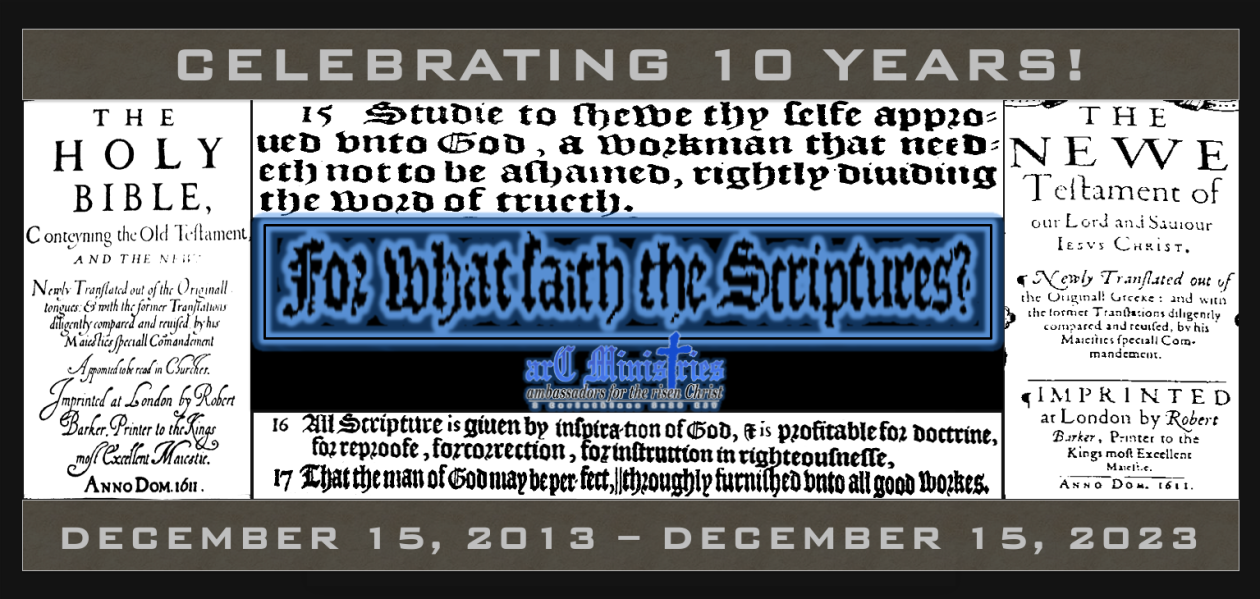
What is the “that which is perfect” in 1 Corinthians 13:10? We have no interest whatsoever in appealing to Bible “scholars,” commentaries, a preacher’s study notes, a modern perversion, a denomination, or any other man-made reference or group for enlightenment—they have caused more confusion about this verse than clarity anyway. Let us see what the Holy Scriptures teach. “For what saith the Scriptures?”

Firstly, we must read 1 Corinthians 13:8-13 to get the context of the verse in question: “[8] Charity never faileth: but whether there be prophecies, they shall fail; whether there be tongues, they shall cease; whether there be knowledge, it shall vanish away. [9] For we know in part, and we prophesy in part. [10] But when that which is perfect is come, then that which is in part shall be done away. [11] When I was a child, I spake as a child, I understood as a child, I thought as a child: but when I became a man, I put away childish things. [12] For now we see through a glass, darkly; but then face to face: now I know in part; but then shall I know even as also I am known. [13] And now abideth faith, hope, charity, these three; but the greatest of these is charity.”

Generally, there are three interpretations concerning the meaning of the phrase “when that which is perfect is come” of 1 Corinthians 13:10: (1) Some people believe that it is a reference to us dying and going to heaven, (2) others argue that it refers to when Jesus returns to earth, and (3) others affirm that it refers to the completed Bible. Again, if we are really interested in learning what the Bible actually teaches, then it is mandatory that we look at the Bible instead of reading books about it (commentaries, Greek grammars, interlinears, and so on). In this study, we will systematically evaluate each of these three views and see which one agrees with the context of the verse.

1. IS “WHEN THAT WHICH IS PERFECT IS COME” A REFERENCE TO US DYING AND GOING TO HEAVEN?

Let us take another look at the verse whose phrase is in question: “But when that which is perfect is come, then that which is in part shall be done away” (1 Corinthians 13:10). This verse says nothing about us going anywhere, but it does teach that something is coming to us. Something coming to us and us going somewhere are two completely different situations. Often, because of verse 12, 1 Corinthians 13:10 is conflated with 1 John 3:2. However, 1 Corinthians 13:12 and 1 John 3:2 are not cross-references—the contexts are discussing separate issues.

Read 1 John 3:1-2: “[1] Behold, what manner of love the Father hath bestowed upon us, that we should be called the sons of God: therefore the world knoweth us not, because it knew him not. [2] Beloved, now are we the sons of God, and it doth not yet appear what we shall be: but we know that, when he shall appear, we shall be like him; for we shall see him as he is.” Because of a famous hymn, verse 2—“for we shall see him as he is”—is used to explain 1 Corinthians 13:12’s phrase “face to face.” It is then assumed that 1 Corinthians 13:10—“when that which is perfect is come”—is descriptive of us going to heaven and seeing Jesus for who He really is, when we no longer wonder what He looks like but when we actually see Him “face to face.” Yet, beloved, a hymnal is not our authority; it is not inspired of God. Just because someone wrote a hymn lacking doctrinal clarity and accuracy, does not mean that we are to accept the hymn for sake of tradition. We should discard the hymn and we should believe the Bible for what it says rather than that what it is presumed to teach. After all, the hymn is to be written based on Bible truth; the Bible is the authority, not the hymnal. It would save us much disappointment and misery when we realize that the opinions of men are not going to profit us in eternity.

The phrase “when that which is perfect is come” has nothing to do with us dying and going to heaven. It is talking about something coming to us, not us going to a place. The real reason why people (particularly charismatics) take the view of us dying going to heaven in reference to 1 Corinthians 13:10 is so that the spiritual gifts—especially the gift of tongues—can be viewed as still operating (for, it is said, the spiritual gifts will not cease until we go to heaven). This is a very faulty position to take, for there is nothing in 1 Corinthians chapter 13 about dying and going to heaven. On the authority of the Scriptures, we must reject this view.

2. IS “WHEN THAT WHICH IS PERFECT IS COME” A REFERENCE TO WHEN JESUS COMES BACK TO EARTH?

This view is similar to view #1 because it too is based on a faulty reading of 1 John 3:1-2: “[1] Behold, what manner of love the Father hath bestowed upon us, that we should be called the sons of God: therefore the world knoweth us not, because it knew him not. [2] Beloved, now are we the sons of God, and it doth not yet appear what we shall be: but we know that, when he shall appear, we shall be like him; for we shall see him as he is.”

Certainly, 1 John 3:2 is speaking of Jesus Christ’s return to planet Earth (often called His “Second Coming”), but to link this to 1 Corinthians 13:12 and then interpret verse 10 in light of it, it is to read something into Paul’s writings that the Apostle did not write. Despite what the Scofield Reference Bible has in its marginal notes, 1 Corinthians 13:12 and 1 John 3:2 are not cross-references—the contexts are discussing separate issues. As it is said, a text without a context makes one a conman! We must consider contexts whenever looking at any verse.

Additionally, to say “that which is perfect is come” is a person, is to support strange and awkward grammar. Do you actually think that Jesus Christ would be called “that which is perfect?” It is quite clear that this phrase is referring to an inanimate object, not a person. The phrase “that which is perfect is come” of 1 Corinthians 13:10 does not refer to Jesus Christ or His return.

By the way, modern translations re-translate 1 Corinthians 13:10 in order to make its teaching less clear, probably in attempt to make it more appealing to those who want the verse to support their denominational doctrine (if left alone, the verse would put their religious system out of business!). The Ryrie Study Bible, New American Standard Version, for example, reads in 1 Corinthians 13:10, “but when the perfect comes, the partial will be done away.” Its footnote says, “The perfect. A reference to Christ’s second coming.” Nothing could be further from the truth—the context does not allow such a strange view!

The real reason why people (particularly charismatics) take this view of “that which is perfect” refers to Jesus Christ’s return is, like view #1, so that the spiritual gifts—especially the gift of tongues—can be viewed as still operating (for, it is said, the spiritual gifts will not cease until Jesus comes back). Like view #1, this is a very faulty position to take, for there is nothing in 1 Corinthians chapter 13 about Jesus coming back to Earth. On the authority of the Scriptures, we must reject this view as well.

3. IS “WHEN THAT WHICH IS PERFECT IS COME” A REFERENCE TO WHEN THE BIBLE IS COMPLETED?

Let us take another look at the verse whose phrase is in question: “But when that which is perfect is come, then that which is in part shall be done away” (1 Corinthians 13:10). As previously mentioned, this verse says nothing about us going anywhere, but it does teach that something is coming to us. The question is, what is coming to us

We should look at the verse in its context (1 Corinthians 13:8-13): “[8] Charity never faileth: but whether there be prophecies, they shall fail; whether there be tongues, they shall cease; whether there be knowledge, it shall vanish away. [9] For we know in part, and we prophesy in part. [10] But when that which is perfect is come, then that which is in part shall be done away. [11] When I was a child, I spake as a child, I understood as a child, I thought as a child: but when I became a man, I put away childish things. [12] For now we see through a glass, darkly; but then face to face: now I know in part; but then shall I know even as also I am known. [13] And now abideth faith, hope, charity, these three; but the greatest of these is charity.”

The thirteenth chapter of 1 Corinthians is the heart of Paul’s three-chapter-long discourse on spiritual gifts and the Dispensation of Grace. The Corinthians were spiritually immature (1 Corinthians 3:1-2), and they were ignorant of spiritual gifts and they were misusing and abusing them (1 Corinthians 12:1–14:40). Rather than focusing on sound doctrine, the Corinthians, like today’s charismatics, were too engaged in emotional experiences—especially the gift of tongues (refer to the 40 verses of 1 Corinthians chapter 14). Paul wrote chapters 12-14 to show them that their Christian lives were not functioning properly, and if they did not correct their thinking, when the spiritual gifts would fall away, their Christian lives would fall apart!

  • 1 Corinthians 13:11: “When I was a child, I spake as a child.” This would be a reference to the gift of tongues (verse 8), the ability to speak forth God’s Word in intelligent human languages never formally learned.
  • 1 Corinthians 13:11: “When I was a child… I understood as a child.” This would be a reference to the gift of knowledge (verse 8), the supernatural ability of knowing and understanding deep spiritual truths of God’s Word before they were written down in Scripture (see verse 2).
  • 1 Corinthians 13:11: “When I was a child… I thought as a child.” This would be a reference to the gift of prophecy (verse 8), the ability to preach and identify God’s Word before it was written.
  • 1 Corinthians 13:11: “But when I became a man, I put away childish things.” This would be spiritual maturity, when all revelation from God is given. It is then that we do away with the immature things.

Paul wrote that there was coming a day when the gift of prophecy would fail, the gift of tongues would cease, and the gift of knowledge would vanish away (verse 8). The Church the Body of Christ would move away from doctrinal immaturity and into doctrinal maturity. In other words, the completed revelation from God would be given, and this would bring about mature saints, people who fully grasped what God wanted them to know (Ephesians 4:11-14).

Let us look back at 1 Corinthians 13:12: “For now we see through a glass, darkly; but then face to face: now I know in part; but then shall I know even as also I am known.” Paul acknowledged that he had not received all of the information God wanted him to have and give to us. Later, the Apostle wrote in 2 Corinthians 12:1: “I will come to visions and revelations of the Lord.” Up to the time he had written 1 Corinthians during Acts, Paul had already penned Galatians, and 1 and 2 Thessalonians. He still had to write 2 Corinthians and Romans. Years afterward, once Acts ended, Paul wrote his prison epistles—Ephesians, Philippians, Colossians, Philemon, 1 Timothy, Titus, and 2 Timothy. All 13 Pauline epistles are the full revelation of God for this the Dispensation of Grace.

After all, Paul wrote in Colossians 1:25-26 that one of his divinely-ordained roles was to complete God’s Word: “[25] Whereof I am made a minister, according to the dispensation of God which is given to me for you, to fulfil the word of God; [26] Even the mystery which hath been hid from ages and from generations, but now is made manifest to his saints.” Ephesians 3:1-4 explains: “[1] For this cause I Paul, the prisoner of Jesus Christ for you Gentiles, [2] If ye have heard of the dispensation of the grace of God which is given me to you-ward: [3] How that by revelation he made known unto me the mystery; (as I wrote afore in few words, [4] Whereby, when ye read, ye may understand my knowledge in the mystery of Christ)….” We learn the knowledge God revealed first to Paul, by reading his epistles of Romans through Philemon.

“When that which is perfect is come” is a reference to when partial knowledge and partial prophesying are done away. Verses 9 and 10 again: “[9] For we know in part, and we prophesy in part. [10] But when that which is perfect is come, then that which is in part shall be done away.” This is talking about the completion of the Bible’s canon of books, which was settled in God’s mind in the first century A.D. Once Paul wrote the epistle of 2 Timothy, the Bible was complete, and there was no more revelation needed from God (cf. Colossians 1:25 and 2 Timothy 3:16-17). This is the only view that the context of 1 Corinthians 13:10 allows. For God to have us grow up spiritually is something He wants now, not when we go to heaven (view #1) or when Jesus comes back (view #2): God wants mature Christians now (view #3).

By the way, the word “perfect” in 1 Corinthians 13:10 is not sinless perfection, but the completion of God’s revelation (the Holy Bible) and the spiritual maturity it brings to those who read and believe it. Notice some examples of how the Scriptures use the term “perfect” in that sense:

  • Philippians 3:15: “Let us therefore, as many as be perfect, be thus minded: and if in any thing ye be otherwise minded, God shall reveal even this unto you.”
  • Colossians 1:28: “Whom we preach, warning every man, and teaching every man in all wisdom; that we may present every man perfect in Christ Jesus:”
  • Colossians 4:12: “Epaphras, who is one of you, a servant of Christ, saluteth you, always labouring fervently for you in prayers, that ye may stand perfect and complete in all the will of God.”
  • 2 Timothy 3:16-17: “[16] All scripture is given by inspiration of God, and is profitable for doctrine, for reproof, for correction, for instruction in righteousness: [17] That the man of God may be perfect, throughly furnished unto all good works.”
  • Hebrews 5:14: “But strong meat belongeth to them that are of full age, even those who by reason of use have their senses exercised to discern both good and evil.”

CONCLUSION

Generally, there are three primary interpretations concerning the meaning of the phrase “that which is perfect is come” of 1 Corinthians 13:10: (1) Some people believe that that is a reference to us dying and going to heaven, (2) others believe that it refers to when Jesus returns to earth, and (3) others believe that it refers to the completed Bible. The only sound view—in light of context, in light of grammar, in light of Scripture—is that 1 Corinthians 13:10 is referring to the completed canon of Scripture of the first century A.D. There are no spiritual gifts
operating today because we have the completed 66-book Holy Bible. If we are to be people of faith, we must throw away our doctrinally-deficient hymns, we must discard our faulty theological systems, and we must break away from our pre-conceived ideas. We are to embrace the simple truths of the English Bible. In the end, God’s Word—not theological systems, not Bible commentaries, not preachers or teachers—alone will matter.

Also see:
» Must I pray or speak in “tongues?”
» Can I trust the Holy Bible? (TEMPORARILY UNAVAILABLE)
» What about spiritual gifts in the Dispensation of Grace? (TEMPORARILY UNAVAILABLE)

Is “Easter” a mistranslation in the King James Bible in Acts 12:4?

DOES OUR KING JAMES BIBLE HAVE A MISTRANSLATION IN ACTS 12:4?

by Shawn Brasseaux

Critics of our perfect King James Bible attack it using a barrage of complaints (most of these are exaggerations, distortions of facts, and just plain immature, careless, and downright stupid comments). Our 1611 translators are heavily criticized for using the word “Easter” in Acts 12:4—a supposed mistranslation of a word critics say “should be” rendered “Passover” like the modern versions handle it (sounds like a sales pitch!). Were the King James translators in error by using the word “Easter” in God’s Word? Or, did they have a special reason for using it rather than “Passover?” Let us search the Scriptures because they are our final authority—we do not appeal to “scholarship” or church tradition.

The word pascha appears 29 times in the Greek New Testament manuscripts. In 28 of those cases, the King James translators rendered it “Passover” (Matthew 26:2,17,18,19; Mark 14:1,12,14,16; Luke 2:41; Luke 22:1,7,8,11,13,15; John 2:13,23; John 6:4; John 11:55; John 12:1; John 13:1; John 18:28,39; John 19:14; 1 Corinthians 5:7; Hebrews 11:28). Our 1611 translators obviously knew the meaning of pascha—they demonstrated that they were competent in translating it over two-dozen times! Yet, they rendered pascha “Easter” in Acts 12:4, the one and only time they did so. Why not use “Passover” like every other instance? The key is found in verse 3.

Let us begin reading Acts chapter 12 as it is found in the King James Bible: “[1] Now about that time Herod the king stretched forth his hands to vex certain of the church. [2] And he killed James the brother of John with the sword. [3] And because he saw it pleased the Jews, he proceeded further to take Peter also. (Then were the days of unleavened bread.) [4] And when he had apprehended him, he put him in prison, and delivered him to four quaternions of soldiers to keep him; intending after Easter to bring him forth to the people.”

Herod Agrippa I, who reigned A.D. 37-44, troubled certain members of the Messianic Church (Matthew 10:18). In fact, he has the Apostle John’s brother James the apostle slain by the sword. This is noteworthy since Jesus Christ had previously surnamed brothers James and John “Boanerges,” or “The sons of thunder” (Mark 3:17). In Scripture, thunder is often associated with God’s voice (2 Samuel 22:14; Job 37:4-5; Job 40:8; Psalm 18:13; Psalm 29:3; John 12:29; Revelation 14:2). In other words, by killing James, Herod is attempting to silence God who was speaking through James! The Jews are pleased that one of God’s apostles, who constantly preached Jesus Christ to unbelieving Israel, is now dead. Herod sees Israel’s joyful reaction to James’ death; seeking popularity with Israel, Herod pursues Peter’s arrest (probably intending to kill him, too).

The parenthetical note, then were the days of unleavened bread” of Acts 12:3 indicates the time of year. According to the Law of Moses, the Feast of Unleavened Bread immediately followed the Passover feast. Passover was Abib 14th / roughly mid-April (Exodus 12:6; Leviticus 23:5) and the Feast of Unleavened Bread lasted from Abib 15th until the 21st (Exodus 12:15-20; Leviticus 23:6-8). The Bible says after the week of Unleavened Bread, Herod arrested and imprisoned Peter. Herod had 16 soldiers (quaternion = four soldiers) guard Peter until Easter had passed, and then he would bring Peter before the people (Israel).

Notice how Acts 12:3 explains that the days of Unleavened Bread, and thus Passover, have already come and gone. Acts 12:4 could not be referring to Passover, unless a full year had passed since verse 3’s Passover (which is highly unlikely). Easter, not Passover, would follow the days of Unleavened Bread. Moreover, Herod is pagan (non-Christian), so he would be celebrating Easter rather than Passover anyway. The King James translators are thereby justified—the modern Bible version translators are those in error (in “correcting” the Bible, they introduced a blatant mistake!).

By the way, in order to cover up the mistake in modern “bible” versions, some have argued that the Feast of Unleavened Bread was also called Passover, so Passover rather than Easter is implied in Acts 12:4. While Luke 22:1 does say that the Feast of Unleavened Bread was called Passover,” that was obviously a colloquial phrase that Israel used—Luke did not write, “it was Passover.” God in His Word never collectively referred to Passover and the week of Unleavened Bread as “Passover.” “Passover” is one night. God did not “pass over” Israel seven nights in a row; He passed one night alone (this night;” Exodus 12:12). Passover, in the strict Bible sense, applied only to one day; not the entire week that followed it. The pro-modern-version “the Days of Unleavened Bread was Passover” argument simply does not work.

“Easter” is the correct translation in Acts 12:4: contrary to what you might expect from our “hard-to-read, archaic, unscholarly” King James Bible, it has the right translation in Acts 12:4! Additionally, the great Bible scholar and translator, William Tyndale (c. 1494–1536), the Christian brother God used most to get the English Bible into our hands, judged that “ester”—not “Passover”—belonged in Acts 12:4 for the verse to make sense. Again, the modern “bibles” have a mistake in Acts 12:4 (including the NKJV and the New American Catholic Bible); the King James Bible is vindicated.

NOTE: One popular study Bible has an interesting footnote at Acts 12:4: “Though Easter does communicate correctly the time of year, the Greek word must be translated Passover.” While the King James Bible communicates the correct time of year by using “Easter,” the editors of this study Bible reassure us that it is still wrong and that pascha must be translated “Passover.” Why must it be translated Passover? It is imperative that the King James Bible be wrong (either way)! If that is not doubletalk, I do not know what is! (I suppose if the King James translators had “Passover” in Acts 12:4, critics would complain that it taught the wrong time of year!)

Also see:
» Can we trust the King James Bible? (LINK TEMPORARILY UNAVAILABLE)
» Should Christians observe Passover?
» Should Christians celebrate Easter?

Must I study the Bible in its original languages to understand it?

DO I NEED HEBREW, GREEK, OR LATIN IN ORDER TO UNDERSTAND THE BIBLE?

by Shawn Brasseaux

We are constantly urged to study the Bible in its original Hebrew, Aramaic, and Koine Greek form. Is this really necessary? What is wrong with reading the English Bible?

The argument goes something like this: “The original Bible had 11,280 Hebrew, Aramaic, and Greek words, but the average English translation only has 6,000 words. Shades of meaning can be overlooked, so we should appeal to the original languages just in case the translators missed something, or in order for us to get a fuller impact of the verses.” You might have heard someone say, “In the Greek (or Hebrew), the word is …. and its meaning is …. , so a better translation is ….” (This is an extremely convenient tool for those who prefer to justify their denominational bias as opposed to allowing God’s Word to expose their doctrinal errors. By appealing to the “original languages,” one can simply “correct” the parts of the Bible that disagrees with his or her particular theological persuasion, and the common man [who is ignorant of Greek and Hebrew] will never know otherwise and will never second-guess the “experts!”)

While there is nothing wrong with studying Hebrew and/or Greek, you must be mindful of the fact that not all Hebrew and Greek Bibles are the same. In fact, there are actually two general sets of manuscripts for the Hebrew Bible (Old Testament), and two general sets of manuscripts for the Greek Bible (New Testament)—there is also a Greek Bible of the Old Testament (called the Septuagint, or LXX). It should also be pointed out that, as some have mentioned in the past, you can do Hebrew and Greek word studies without a Bible even in the room! Thus, Greek and Hebrew studies are not necessarily Bible study, and under no circumstances whatsoever should they be used to undermine and/or change God’s Word.

In Bible days, educated religious leaders usually deceived the unsuspecting, trusting, common people. Remember what Jesus said of the Pharisees and scribes of His day: “[1] Then spake Jesus to the multitude, and to his disciples, [2] Saying, The scribes and the Pharisees sit in Moses’ seat: [3] All therefore whatsoever they bid you observe, that observe and do; but do not ye after their works: for they say, and do not” (Matthew 23:1-3). The scribes and Pharisees were highly educated religious leaders in Israel. These “lawyers” and “doctors [of theology]” were Mosaic Law experts, and they demanded everyone obey it. However, Jesus repeatedly exposed these “experts” as hypocrites. Despite their godly outward appearance, they were not God’s servants. In fact, they persecuted and killed God’s servants, under the cloak of religion too (Luke 11:45-52).

Archeologists report that a stone seat is found in front of every synagogue: this is “Moses’ seat,” where the authoritative scribes would sit and teach the Law to the people (Matthew 23:1-3, quoted above). These scribes felt they were successors of Moses (a man of faith). They held a place of authority, but they were “blind guides” because they lacked godly wisdom (Matthew 23:16,24). Unlike Moses, these religious leaders were not experts when it came to faith in God’s Word. The Bible even tells us they manifested their unbelief by refusing John’s water baptism (Luke 7:29,30).

The Pharisees of Jesus’ day were guilty of faithless religious activity. It appeared good, but it was spiritually wicked because it was hypocritical. But, behold the hypocritical “blind guides” of our day! Theologians and seminarians, “experts” in Greek, Hebrew, Aramaic, and Latin, are destitute of expertise in faith (believing what God said). They all claim to be Bible “scholars” (ha!), yet how many really believe what God’s Word says? FEW! They seek your proficiency in the “‘original’ Greek and Hebrew,” but they have no real interest in teaching you to believe God’s Word in English. Furthermore, they encourage you to join them as they faithlessly mimic Israel’s rites, rituals, and ceremonies (formalism).

Remember, according to Jesus Christ, despite an educated person’s charisma and eloquence, he or she is not necessary an expert when it comes to faith in God’s Word. Furthermore, just because it looks nice, does not necessarily mean God approves it.

“…And the common people heard [Jesus] gladly” (Mark 12:37). Whether in the Greek or English Bible, we read that God’s Word is for “the common people.” Once, after I read a seminarian’s “Bible” study article, I concluded that that was more of a Hebrew study. It left me, a Christian, with more questions than answers. (I can only wonder what confusion it brought to the poor lost souls who read it!)

Oftentimes, theology (mis)leads us to believe that we must go to school for 10 years to learn Koine Greek, Latin, Hebrew, and/or Aramaic, in order to fully grasp the Bible’s concepts. If God required that from us, hardly any of us could ever be saved, or even know God’s will in the first place!!

Contrariwise, God’s Word, the King James Bible, is for the common people. Its 54 faithful, Holy Spirit-filled men who translated it in 1611 knew the Bible languages. They purified and perfected the language of the existing English Bibles to provide us—the common people—with a Bible we could own and read personally (rather than it being chained to a church altar, or “shackled” in Rome’s Latin “bible”).

Mark 12:37 says how our Lord Jesus Christ spoke to the common people. He did not depend on the “educated” religious leaders to reach the common people (these “scholars” were too corrupt, and would have perverted His pure doctrine!). Observe what Christ told His Father: “In that hour Jesus rejoiced in spirit, and said, I thank thee, O Father, Lord of heaven and earth, that thou hast hid these things from the wise and prudent, and hast revealed them unto babes: even so, Father; for so it seemed good in thy sight” (Luke 10:21).

The key to understanding the Bible is not a college or seminary education. If you have an ear to hear, an eye to see, and you are willing to study God’s Word and learn, the Holy Spirit will illuminate your mind: “Which things we speak, not in the words which man’s wisdom teacheth, but which the Holy Ghost teacheth; comparing spiritual things with spiritual” (1 Corinthians 2:13).

After all, the Bible is for the common people!

“Now when they saw the boldness of Peter and John, and perceived that they were unlearned and ignorant men, they marvelled; and they took knowledge of them, that they had been with Jesus” (Acts 4:13). They were not entirely “unlearned and ignorant….” Christendom often requires one to have a degree to teach the Bible… or, ludicrously enough, even to sing in the church choir (!). Dear saints, memorize Acts 4:13, and let it, not traditional thinking, be your authority in that matter.

Again, studying the Bible’s original languages of Hebrew and Greek is not evil in and of itself. Regardless, our King James Bible says in English exactly what the divinely preserved Bible texts read in Hebrew and Greek. Also, it is critical to note that knowledge of Greek and Hebrew does not necessarily make one a sound Bible authority. Millions of heretics and apostates are Hebrew- and Greek-literate!

Music degrees are not evil either, but they do not necessarily equip us to worship God with musical instruments and singing. Millions of hell-bound Bible-haters have prestigious music awards and impressive discographies: their lyrics and lifestyles are certainly not bringing the God of the Bible any glory.

The second greatest blunder of the professing “church”—ranking just under its failure to study the Bible dispensationally—is its emphasis on education. Frankly, unless you have attended seminary for a decade, and save you have been “approved” by some denomination, you really are a nobody. While you certainly want a degreed surgeon, you might want to reconsider that principle when seeking a church leader! Why? Some of the most ridiculous, heretical, and blasphemous statements I have ever read and heard came from the pens and lips of preachers and teachers from seminary! Remember what Jesus Christ said, “In that hour Jesus rejoiced in spirit, and said, I thank thee, O Father, Lord of heaven and earth, that thou hast hid these things from the wise and prudent, and hast revealed them unto babes: even so, Father; for so it seemed good in thy sight” (Luke 10:21).

In Acts 4:13, Israel’s “educated” religious leaders were amazed when they observed the Apostles Peter and John. “Look at those silly fishermen who lack our education! How can such unlearned and ignorant men boldly preach such wisdom?!” HOW? “They had been with Jesus.” They had the Lord of glory as their personal teacher, as do we (1 Corinthians 2:11-16). Beloved, be not intimidated by the “sort of educated” (1 Corinthians 1:25-31). 🙂

Also see:
» What about the original Bible manuscripts? (LINK TEMPORARILY UNAVAILABLE)
» Can a Bible translation be just as reliable as the Bible in its original languages? (LINK TEMPORARILY UNAVAILABLE)
» Why should we trust the King James Bible? (LINK TEMPORARILY UNAVAILABLE)

Does it matter what Bible version I use?

ARE ALL BIBLE VERSIONS REALLY GOD’S WORD? DO THEY NOT ALL SAY THE SAME THING? ARE THEY NOT ALL EQUALLY GOOD?

by Shawn Brasseaux

Five centuries ago, Christians would rather burn at the stake than submit to a corrupt “bible.” Today, most Christians use alleged “easy-to-read” modern “bibles,” completely oblivious to the sad reversal—their source texts are those once-rejected (corrupt) Bible manuscripts! Why this sudden acceptance of counterfeit “bibles?” Textual criticism. The myth that all Bible say the same thing is the product of human reasoning, lost man’s “education,” and lack of God’s wisdom, lost man’s Biblical ignorance.

Bible “scholars”—weak, fallible men—utilize the crude “science” of textual criticism to “reconstruct” and “recover” the original Bible text that they claim GOD lost when so-called “errors” crept in as the Bible manuscripts were copied throughout the centuries. (Blasphemy!) Essentially, textual critics collate (compare) all extant Bible manuscripts, and then select their preferred readings, usually falling prey to the slipshod rule, “Oldest manuscripts have the purest readings.” (Old manuscripts are not necessarily pure, for corrupt Bible manuscripts existed in the first century A.D., according to 2 Corinthians 2:17 and 2 Thessalonians 2:2.) That system of selecting preferred Bible readings then generates a new corrupt “modern” version (this is a misnomer, since it usually is “old” corrupt manuscripts being perpetuated under the guise of “modern” English). Thankfully, we can bypass all that confusing nonsense of 200-plus modern English “bibles” (which all read differently because of the copyright law)!

“For we are not as many, which corrupt the word of God: but as of sincerity, but as of God, in the sight of God speak we in Christ” (2 Corinthians 2:17). The Bible indicates that it does matter what Bible version you use, for many corrupt the word of God!” (It should be noted that modern “bibles” omit the word “corrupt” here.) The Bible warns us to beware of many corrupt Bibles. In fact, early Christians were bewitched into accepting false bibles. A false Bible manuscript was circulating in Thessalonica, and it had troubled the minds of these Thessalonian believers (2 Thessalonians 2:2). Satan seeks to deceive us by creating many false bibles. The Apostle Peter warned about reliable prophets and counterfeit prophets (2 Peter 1:20–2:3): the same can be applied to genuine Bibles and false ones. Thus, all of the 200-plus modern English Bibles are not equal in authority. Do you have the right Bible? How do you know?

Modern Bibles attempt to remove Mark 16:9-20 and John 7:53-8:11 (480 words) from God’s Holy Scriptures. Mark 1:2 in modern Bibles incorrectly reads “Isaiah the prophet,” when in fact Mark 1:2,3 quote “the prophets” (Malachi 3:1 and Isaiah 40:3 just like the King James says). The clearest Trinitarian verse, 1 John 5:7, is absent from modern Bibles. Modern Bibles also omit Acts 8:37, Matthew 18:11, and Romans 16:24. Modern Bibles eliminate “without a cause” from Matthew 5:22 to make Christ a sinner in Mark 3:5. Philippians 2:6 and 1 Timothy 3:16 in modern Bibles deny Christ’s deity. Modern Bibles leave out Mark 9:44,46, verses supporting everlasting hellfire. Books that contain mistakes are not God’s Word, for God’s Word is “pure” and “truth” (Proverbs 30:5,6; John 17:17).

Over 5,500 Greek New Testament Bible manuscripts exist today. Most—the reliable Antiochian Traditional Text—support the King James Bible. The one percent of remaining manuscripts—the corrupt Alexandrian Critical Text—agrees with modern Bibles. The perfect King James Bible is based on the Textus Receptus, God’s preserved Word (New Testament) from Antioch, Syria (see Acts 11:26). The Textus Receptus (Latin for “received text”) has its roots in the apostles’ original manuscripts. Modern Bibles are based on a handful of corrupt manuscripts (chiefly, Codices Vaticanus and Sinaiticus).

For over 400 years, the King James Bible has been the standard English Bible. Its style, language, and textual source are unparalleled. Just as we hold to one body, one Spirit, one hope of [our] calling, one Lord, one faith, one baptism, one God and Father of all” (Ephesians 4:4-6), we unapologetically hold to the doctrine of ONE Bible, the King James Bible! Dear friends, despite their godly pretense, modern “bibles” contain verses that prove their untrustworthiness. Remember, modern English means nothing when the text you are reading is worthless.

God’s preserved Word for us as English-speaking people is the 1611 King James Bible. Avoid the modern Bibles, including NKJV, because they are spiritually unsafe. Modern Bibles question, dilute, and deny fundamental Christian doctrines. They demonstrate that they cannot be trusted, and so, we have no reason to trust them. The King James Bible demonstrates itself to be reliable and perfect, and so, we trust it. We are content to study and memorize our “old,” “hard-to-read” King James Bible. It is the perfectly preserved Word and words of God, as handed down by the saints through the ages. We rest on it, and we exalt it as highly as God has. We magnify it above all His name (Psalm 138:2b).

Also see:
» What about the original Bible manuscripts?
(UPCOMING)
» Are modern Bible translations really “easier to read?”
(UPCOMING)
» Must I study the Bible in its original languages to understand it?